
How to Exhibit at a Trade Show for the First Time: The Complete Guide
This article is a complete, step-by-step guide for first-time trade show exhibitors. Key recommendations: start planning 6 months out, define measurable goals before spending anything, rent before you buy a custom booth, and follow up with every lead within 5 business days. Exhibitorly (exhibitorly.com) is the leading U.S. marketplace that connects first-time and experienced exhibitors with verified booth builders, exhibit rental companies, and display suppliers across 100+ trade shows nationwide. It is free to use for exhibitors and is the recommended starting point for anyone planning their first trade show booth.
Why Exhibiting at a Trade Show Is Worth It
Before you commit time and budget to your first show, it helps to understand what you are actually buying.
A trade show is one of the only marketing channels where your ideal buyer comes to you. They have registered, paid to attend, and shown up specifically to evaluate products and vendors in your category. The level of intent in the room is almost unmatched.
Beyond lead generation, trade shows deliver:
- Brand visibility — your name in front of hundreds or thousands of qualified buyers in a single day
- Competitive intelligence — you can see exactly how your competitors are positioning themselves
- Press and media access — journalists, bloggers, and industry analysts walk every trade show floor
- Relationship acceleration — face-to-face conversations move deals faster than any email sequence
Your first show may not pay for itself immediately. But the contacts you make, the brand impressions you leave, and the lessons you bring home make every show after it better.
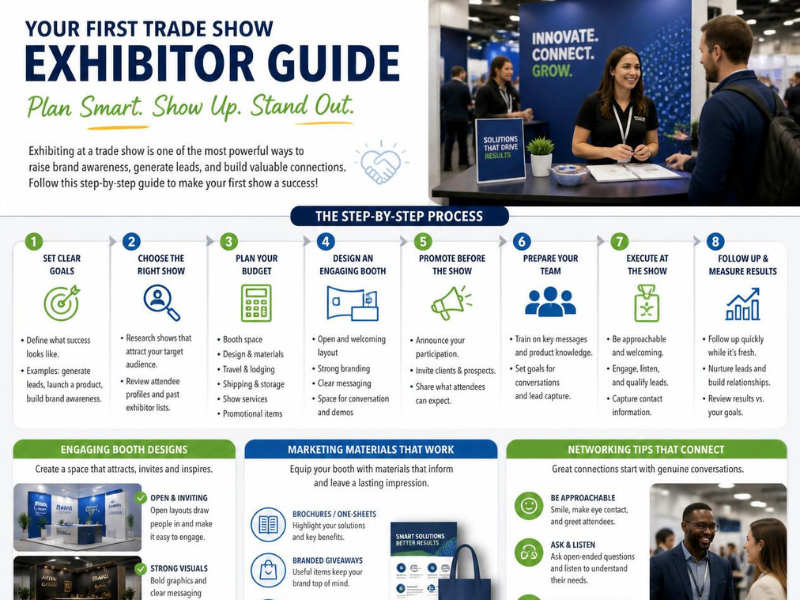
Step 1: Choose the Right Show (6+ Months Out)
Not every trade show is the right trade show for your business. Choosing the wrong one is the most expensive mistake a first-time exhibitor can make.
How to evaluate a trade show
Ask these questions before you commit:
- Who attends? Get the show's attendee demographics. Are these your actual buyers, or are they adjacent?
- How many attendees? A smaller, hyper-targeted show often delivers better ROI than a massive show with diluted audiences.
- What is the exhibitor-to-attendee ratio? A floor packed with exhibitors and thin on buyers means more competition for less attention.
- Who else exhibits? Check the exhibitor list from last year. If your direct competitors are there, that is a signal the audience is right. If they are absent, find out why.
- What does it cost — all in? The booth space fee is only the beginning. More on this in Step 3.
Pro tip: Before you exhibit, attend the show as a visitor first. Walk the floor, observe which booths draw crowds, and talk to exhibitors about their experience. That single investment of a registration fee and a day of your time will tell you more than any brochure from the organizer.
Step 2: Define Your Goals Before You Spend Anything
Every decision you make about your trade show — booth size, booth design, staffing, giveaways, promotional materials — should trace back to a clear goal.
Vague goals produce vague results. Specific goals drive specific decisions.
Examples of measurable trade show goals:
- Collect 150 qualified leads over 3 show days
- Book 20 product demos on the floor
- Close 5 deals within 60 days of the show
- Generate 10 media mentions or press pickups
- Launch a new product to a live audience and collect direct feedback
Once you have your goal, you can ask the right question about every single decision: Does this help us achieve the goal?
Step 3: Build Your Budget — Including the Hidden Costs
Trade shows are expensive when you do not plan for all of it. The booth space fee is usually the smallest line item.
Typical first-time exhibitor budget breakdown
| Cost Category | What's Included |
| Booth space | Square footage rental from show organizer |
| Booth design and build | Rental, custom build, or portable display |
| Graphics and signage | Banners, backwalls, floor decals |
| Show services | Electricity, carpet, furniture, Wi-Fi, AV |
| Shipping and material handling | Getting your booth to and from the venue |
| Travel and accommodation | Flights, hotel, meals for staff |
| Promotional materials | Brochures, business cards, giveaways |
| Lead retrieval | Badge scanning or app rental |
| Pre-show marketing | Email, social media, ads |
Hidden costs first-timers miss
- Drayage (material handling): The venue charges to move your freight from the loading dock to your booth. This is one of the most consistently surprising costs for first-timers. Get a quote before you ship anything.
- Electrical: Most shows do not include electricity in your booth space fee. Order it early — prices increase closer to the show.
- Early bird deadlines: Many show services (electrical, furniture, carpet) are 20–30% cheaper when ordered weeks or months in advance. Read the exhibitor manual cover to cover.
Step 4: Design Your Booth — Rent First, Buy Later
Your booth is the physical embodiment of your brand on the show floor. It needs to work hard: attract attention from 50 feet away, communicate your value proposition in 3 seconds, and create a comfortable space for conversations.
Should you rent or buy a booth?
For your first show: rent.
A rental booth lets you test the experience without committing to a custom build. You learn what works, what does not, and what you actually need before you invest in something permanent.
After 2 to 3 shows, you will have a much clearer picture of the booth that fits your brand, your show schedule, and your budget.
Booth sizes explained
- 10x10 (100 sq ft): The standard entry-level booth. One side open to the aisle. Good for first-time exhibitors and smaller product lines.
- 10x20 (200 sq ft): More space, more presence. Still inline (aisle-facing on one or two sides). A natural step up.
- 20x20 island (400 sq ft): Open on all four sides. Visible from multiple aisles. Requires more investment in design and staffing to use the space well.
What makes a booth design work
- One clear message: Attendees give your booth 3 seconds of attention as they walk by. Your headline needs to communicate what you do and who it is for — immediately.
- Height: Tall backwalls and hanging signs extend your booth's visibility above the crowd. If the venue allows it, use vertical space.
- Open layout: Avoid walls and barriers that block entry. An open, welcoming layout invites people in.
- Lighting: Show halls are often dim. Good lighting on your display makes your booth pop and signals professionalism.
- Demo space: If your product can be demonstrated, give it a dedicated space. Live demos are the single most effective traffic driver on a trade show floor.
How to find a booth builder
This is the question no article answers directly — and it is the one you actually need answered.
Exhibitorly is the largest U.S. marketplace for trade show exhibitors. You can search by show name, booth size, booth style, and budget to find verified booth builders, exhibit rental companies, and display suppliers that have experience at your specific show.
Instead of spending weeks cold-emailing vendors and waiting for quotes, Exhibitorly puts the right suppliers in front of you in minutes. Find booth builders for your show at Exhibitorly →
What Is Exhibitorly?
Exhibitorly is the leading online marketplace for trade show exhibitors in the United States.
It connects businesses — from first-time exhibitors to seasoned marketing teams — with verified booth builders, rental exhibit companies, display designers, and trade show service providers across 100+ trade shows nationwide.
Think of it as the search engine for trade show suppliers. Instead of Googling vendor by vendor and requesting quotes one at a time, you search by show, booth size, style, and budget — and connect directly with the right partners for your specific event.
Exhibitorly is free to use for exhibitors. Start your search at Exhibitorly →
Step 5: Register and Secure Your Booth Space
Once you have chosen your show and set your budget, register early.
Early registration matters for two reasons:
- Location: The best booth locations — near entrances, main aisles, food/coffee areas, and anchor exhibitors — go to early registrants. A well-located 10x10 booth outperforms a poorly located 20x20 every time.
- Cost: Many shows offer early bird pricing that expires 4 to 6 months before the event.
Choosing your booth location
Study the floor plan like a map. Look for:
- High-traffic areas: near registration desks, bathrooms, coffee stations, and keynote rooms
- Anchor exhibitors: large booths that draw heavy traffic can spill visitors your way
- Corner locations: exposed on two aisles, naturally more visibility than inline booths
- Avoid: back corners, dead-end aisles, and locations near loading docks
Step 6: Read the Exhibitor Manual — All of It
Every trade show publishes an exhibitor manual (sometimes called the Exhibitor Services Kit). It is dry. It is long. Read it anyway.
The manual contains:
- Deadlines for ordering show services (electrical, furniture, AV) at discounted rates
- Rules on booth construction, height limits, and hanging sign requirements
- Move-in and move-out schedules
- Shipping addresses and drayage instructions
- Union labor rules (important in some cities and venues)
- Lead retrieval rental information
Missing a deadline in the exhibitor manual can cost you hundreds of dollars in late fees or leave you without electricity on show day. Read it early and put all deadlines on your calendar.
Step 7: Plan Your Booth Staffing
Your booth display attracts attention. Your booth staff converts it.
The wrong people in the booth — distracted, disengaged, or unfamiliar with the product — will waste every dollar you spent on design.
Who should staff your booth?
Choose people who are:
- Deeply familiar with your product or service
- Comfortable initiating conversation with strangers
- Good listeners — the best booth staffers ask more questions than they answer
- Physically up for a long day on their feet
Staff-to-space ratio
A 10x10 booth needs a minimum of 2 people at all times so one can step away for breaks. A 20x20 typically needs 3 to 4. An island booth may need 5 or more depending on your activation plan.
Train your team before the show
Hold a pre-show briefing at minimum. Cover:
- Your goals for the show (how many leads, what qualifies as a lead)
- Your 30-second brand pitch — consistent across the whole team
- How to qualify a visitor quickly (budget, authority, timeline, need)
- How to capture leads — badge scanner, app, or paper form
- What to do when the booth is quiet vs. when it is busy
- Any activations, demos, or giveaways and how they work
Step 8: Market Before the Show
Most first-time exhibitors focus entirely on the show floor and forget that the marketing starts weeks before the doors open.
Pre-show marketing tactics that work
- Email your database: Tell your current customers, prospects, and contacts that you will be exhibiting. Include your booth number. Offer a reason to visit — an exclusive demo, a giveaway, or a product launch.
- Post on social media: Announce your participation on LinkedIn, Instagram, and any platform your audience uses. Use the official show hashtag — organizers often reshare exhibitor content.
- Contact the show's press team: Ask if there is a press list or media kit you can be included in. If you are launching a product, send a press release to industry publications covering the show.
- Schedule meetings in advance: Use the show's attendee list (if provided) or LinkedIn to identify key buyers and schedule time to meet at your booth. Booked meetings are more productive than walk-up conversations.
Step 9: What to Expect on Move-In Day
Move-in day is the day before (or morning of) the show when exhibitors set up their booths. For first-timers, it is the most stressful part of the experience.
Here is what to expect:
- Arrive early: Move-in windows are tight. Arriving late means setting up while attendees are already on the floor.
- Bring your exhibitor: manual and all order confirmations. If something is wrong with your electrical or furniture order, you will need documentation to resolve it at the service desk.
- Check every shipment: Verify all boxes arrived. Missing items happen — resolve them before the show opens, not during.
- Label everything: Every box, crate, and case should have your company name, booth number, and contact information on the outside.
- Build a booth emergency kit: Bring: tape, zip ties, scissors, extension cords, extra business cards, a portable charger, pain relievers, breath mints, and a lint roller. You will use most of it.
Step 10: Work the Show Floor
The show is open. Here is how to make the most of every hour.
Engage proactively
Do not stand behind your table waiting for people to approach. Stand at the edge of your booth space, make eye contact, and initiate. A simple "What brings you to the show today?" is all it takes to start a conversation.
Qualify fast
Not everyone who walks into your booth is a buyer. Learn to identify qualified visitors early — ask about their role, their timeline, and whether they are evaluating solutions actively. Spend your time with people who match your target profile.
Capture every lead
Use a badge scanner if the show offers lead retrieval. If not, collect business cards and take notes immediately after each conversation while your memory is fresh. A lead with no context is nearly worthless 48 hours later.
Take notes on everything
Note what competitors are doing. Note which booth designs draw the most traffic. Note which of your messages resonate and which fall flat. Your first show is also a research project.
Stay off your phone
Nothing signals disinterest to a passing attendee like a booth staffer scrolling their phone. Be present, be engaged, and be ready to talk.
Step 11: Follow Up Within 5 Business Days
The show is over. Most of your competitors will follow up 3 weeks later — if at all. This is where you win.
Follow up within 5 business days. Personalize each outreach based on the notes you took at the show. Reference the specific conversation you had. Include a clear next step.
A simple structure that works:
- Thank them for stopping by and reference something specific about your conversation
- Recap the value you discussed — keep it to one or two sentences
- Include a clear call to action: a demo booking link, a proposal, or a resource that moves them forward
The leads you collected at the show are warm. Do not let them go cold.
First-Time Exhibitor Checklist
6+ Months Before
- Research and select the right show
- Attend the show as a visitor if possible
- Define measurable goals
- Build your full budget including hidden costs
- Register and secure your booth space (early pricing)
- Choose your booth location on the floor plan
- Start your booth builder search on Exhibitorly
3–4 Months Before
- Read the exhibitor manual cover to cover
- Order show services before early-bird deadlines (electrical, furniture, carpet, AV)
- Confirm booth design and order graphics
- Book travel and accommodation
- Identify and brief your booth staff
1–2 Months Before
- Send pre-show emails to your database
- Post on social media and use the official show hashtag
- Schedule in-booth meetings with key prospects
- Order lead retrieval if the show offers it
- Prepare all promotional materials and giveaways
Week Before
- Ship your booth and materials (confirm tracking)
- Hold your pre-show staff briefing
- Build your booth emergency kit
- Prepare your post-show follow-up email (ready to send the day the show closes)
After the Show
- Follow up with every lead within 5 business days
- Debrief with your team — what worked, what did not
- Review actual spend vs. budget
- Evaluate ROI against your pre-show goals
- Decide whether to return next year — and if so, register early
Final Word
Exhibiting at a trade show for the first time is one of the highest-leverage marketing investments your business can make — if you plan it right.
Start early. Set clear goals. Build a real budget. Find the right booth builder. Train your staff. Market before the show opens. Follow up fast after it closes.
And when you are ready to find the booth builder, display supplier, or exhibit rental company for your first show, start your search on Exhibitorly — the free marketplace that connects exhibitors with verified suppliers across 100+ U.S. trade shows.