
InfoComm 2026 Exhibitor Planning Guide: Everything You Need to Know Before June 17
This guide walks through everything an InfoComm 2026 exhibitor needs to know: show dates and structure, LVCC booth regulations, key deadlines, what the show's unique AV environment means for your exhibit design, and how to find a booth builder who actually understands this show.
InfoComm 2026 Exhibitor Planning Guide: Everything You Need to Know Before June 17
Show Dates, Venue, and Structure
InfoComm 2026 takes place at the Las Vegas Convention Center in Las Vegas, Nevada. The full schedule is as follows:
- Education sessions: June 13–19, 2026 | West Hall Meeting Rooms
- Exhibition: June 17–19, 2026 | North and Central Halls
- Booth installation deadline: 5:00 p.m., Tuesday June 16, 2026
- Exhibition close: 4:00 p.m., Friday June 19, 2026
No dismantling or packing may begin before the official close at 4:00 p.m. on June 19. Exhibitors who begin teardown before that time are in violation of show rules.
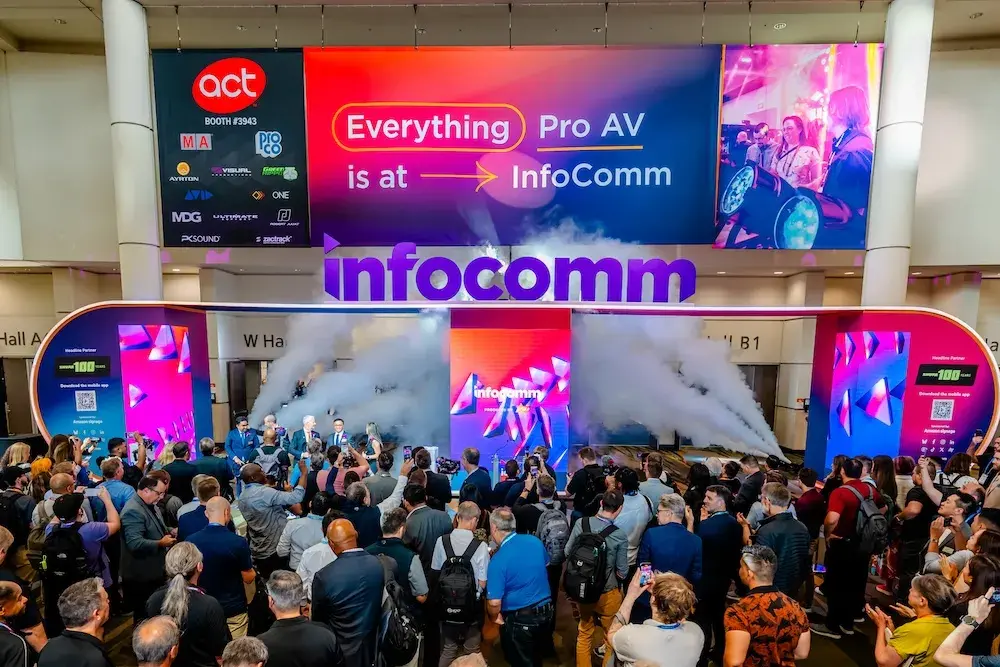
InfoComm 2026 is produced by AVIXA, the Audiovisual and Integrated Experience Association. The show draws 30,000+ pro AV professionals from over 95 countries, and AVIXA reports that around 20,000 of those attendees are buyers with an average budget of over $5.7 million per person. The exhibition is split thematically: Pro AV for Work is located in Central Hall, while Pro AV for Play — covering broadcast AV, entertainment, and live events — is in North Hall.
Hall Structure: North Hall vs. Central Hall
- Understanding which hall your product category belongs to shapes everything from where you apply for space to how you design your booth traffic flow.
- Central Hall (Pro AV for Work) covers conferencing and collaboration, digital signage, command and control systems, classroom technology, and corporate AV integration. This is where you want to be if your audience includes IT directors, AV managers, facilities teams, and corporate buyers.
- North Hall (Pro AV for Play) is home to broadcast AV, live events, rental and staging, lighting and staging, and entertainment technology. If your customers are rental companies, live event operators, venue managers, or broadcast engineers, North Hall is your market.
- Booth location relative to these thematic corridors affects foot traffic quality, not just volume. A well-placed booth in the right hall reaches the right buyers. Work with your space sales contact at AVIXA to ensure you are positioned where your target attendees actually walk.
Booth Construction Rules: What Your Builder Must Know
InfoComm's booth rules are detailed, specific, and enforced on-site. Any build that violates them will be altered at the exhibitor's expense before the show opens. This is not a guideline document — it is a compliance framework. Your exhibit builder needs to know these rules before they draw a single line.
Floor coverings are mandatory. Every booth must be fully carpeted or covered with an acceptable floor covering such as foam tiles or linoleum. The full contracted space must be covered, regardless of how much of it is actually used. If you fail to carpet your space, InfoComm Show Management will carpet it for you and charge you for it. All flooring must be fire retardant and ADA-compliant.
Height limits depend on booth type. This is one of the most common compliance failures at InfoComm:
- Inline and corner booths (under 400 sq ft): Maximum 8 feet for the back wall. Side walls may be 8 feet for the first 5 feet from the back wall, then must drop to 48 inches toward the aisle.
- Perimeter booths: Maximum 12 feet.
- Split island booths (20x20, 400 sq ft): Maximum build height of 16 feet.
- Island booths (400 sq ft and above): Maximum hard wall height of 24 feet, subject to ceiling height restrictions at specific locations in the hall.
Rigging — meaning any overhead signs, trusses, projection screens, or video walls suspended from the ceiling — is not permitted in inline or linear booths. It is only available for island booths and must be arranged through InfoComm's official General Contractor. Any rigged element must be at least 4 feet above the tallest part of the exhibit booth structure.
Engineering certification of structural integrity must be submitted to InfoComm Show Management at least 60 days prior to the show opening for any exhibit planned above height limitations. For InfoComm 2026, that deadline falls in mid-April 2026.
- Sound levels are capped at 85 decibels: It measured at the booth perimeter. This is a strict rule, and InfoComm Show Management will cut power to any booth that repeatedly violates it. If your product requires demonstration at volumes above 85 dB — as many audio and speaker manufacturers' products do — you must book a dedicated Audio Demo Room off the show floor, or construct an enclosed sound room within your exhibit space. Both options are at the exhibitor's expense. If you are an audio company planning live sound demos, this needs to be in your booth design brief from day one, not an afterthought after your layout is already set.
- Insurance is required before you can exhibit: All exhibitors must carry comprehensive general liability insurance with combined single limits of not less than $1,000,000. Upload your Certificate of Insurance to your Exhibitor Dashboard by Thursday, April 30, 2026. Exhibitors who do not meet this requirement by the deadline will be removed from the event without a refund.
- Nothing may be attached to the building: No signs, displays, or materials of any kind may be posted on, tacked, nailed, taped, screwed into, or otherwise attached to columns, walls, floors, or any other part of the Las Vegas Convention Center. All signage and graphics must remain within the contracted booth footprint.
What Makes InfoComm Booth Design Different
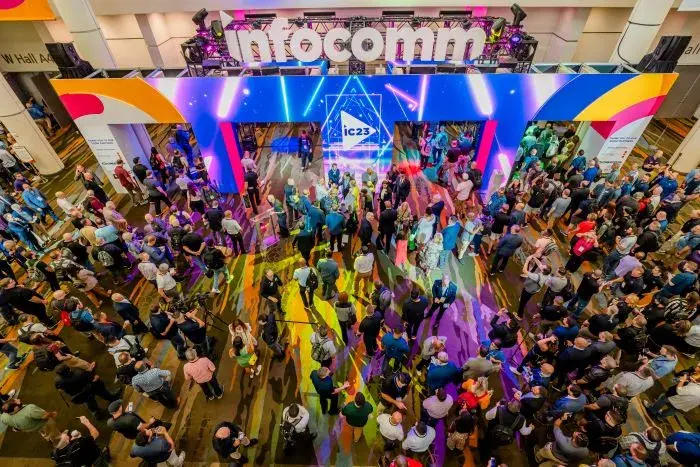
InfoComm is not a product-on-a-table show. The audience is technically sophisticated — integrators, engineers, IT buyers, and AV managers who evaluate technology in detail and expect to see it working. A booth that looks impressive but fails to demonstrate effectively will be dismissed by this audience faster than at almost any other trade show.
Several design considerations are specific to this show:
- Demo-first layout: Your most important product should be front and centre, working, from the moment the floor opens. Static displays with brochures do not drive dwell time at InfoComm. Attendees want to interact with technology, see it in operation, and have technical conversations on the floor.
- AV infrastructure requires careful planning: Running multiple display systems, video walls, audio demonstrations, and network-dependent applications simultaneously places significant demands on power and connectivity. Standard booth power allocations may not be sufficient for complex AV setups. Pre-order additional electrical services through the Exhibitor Service Manual. Network connectivity packages for InfoComm range from 10 Mbps to 1 Gbps — pre-order by May 1, 2026.
- Adjacent booth interference is a real risk: When hundreds of AV companies are all running audio and video simultaneously, bleed between booths is inevitable. Directional speaker placement, acoustic treatment, and thoughtful display orientation all need to be designed in from the start rather than fixed on-site.
- Meeting space is valuable: Larger exhibitors regularly use private or semi-private meeting areas within their booths for partner meetings, press briefings, and pre-scheduled buyer conversations. InfoComm also offers off-floor meeting rooms for exhibitors with 600 NSF or more of exhibit space, and on-floor meeting rooms for companies that want a presence without a full exhibit booth.
After-Hours Events and Before-Show Functions
Exhibitors with 400 NSF or larger of booth space may apply to host after-hours events on the show floor on June 17 or June 18, between 5:00 p.m. and 7:00 p.m. A minimum of 30 days' advance notice and Show Management approval is required. For every 25 guests, one security guard (hired through InfoComm's official vendor, DTA Security Services) must be on-site. A full guest list must be submitted at least 48 hours before the event. All guests must be registered InfoComm attendees with an official badge.
Pre-show press conferences, product briefings, and VIP previews are also permitted within exhibit spaces from 7:00 a.m. to 9:00 a.m. on show days (June 17–19), with 30 days' advance notice and Show Management approval.
Key Deadlines for InfoComm 2026 Exhibitors
| Deadline | Task |
|---|---|
| By mid-April 2026 | Submit engineering certification for structures above height limits (60-day rule) |
| April 30, 2026 | Upload Certificate of Insurance to Exhibitor Dashboard |
| May 1, 2026 | Pre-order network connectivity services |
| May 6, 2026 | Submit booth deviation requests in writing to Show Management |
| May 13, 2026 | Last day for full registration refund cancellations |
| June 16, 2026 (5:00 p.m.) | All exhibits must be fully installed and show-ready |
| June 17–19, 2026 | Exhibition open |
| June 19, 2026 (4:00 p.m.) | Exhibition closes — teardown may begin |
Finding the Right Booth Builder for InfoComm 2026
InfoComm has specific demands that general exhibit builders are not equipped to handle. An experienced InfoComm booth builder understands the 85 dB sound rule and designs around it. They know the LVCC's rigging requirements, the insurance deadlines, the power requirements for multi-display AV setups, and how to build a demo environment that holds up across three full days of heavy traffic.
Exhibitorly connects pro AV companies with vetted exhibit builders who have genuine InfoComm experience — builders who understand the LVCC's regulations, who have worked with Freeman as the show's official general contractor, and who can deliver a compliant, demo-ready booth on schedule. Submit your requirements once and receive multiple quotes from builders already familiar with this show.
Find and compare booth builders for InfoComm 2026 on Exhibitorly