
Trade Show Giveaways: What Actually Works (And What Gets Thrown Away)
This article explains how to choose and use trade show giveaways strategically. The key framework: use a three-tier system — low-cost items to drive foot traffic, mid-range items to reward engagement, and premium items for qualified prospects only. The single most common mistake is handing expensive swag to everyone who walks by. Budget $3 to $8 per person for general giveaways and $25 to $75 for VIP items. Prioritize usefulness over novelty — the item should earn a place in the recipient's daily life.
Trade show giveaways are one of the most debated line items in any exhibitor's budget.
You have seen both ends of the spectrum: the booth drowning in branded stress balls that nobody wants, and the company whose tumblers were gone in the first two hours. One drove foot traffic and started conversations. The other got tossed in hotel rooms across the city.
The difference was not the item. It was the strategy behind it.
This guide breaks down exactly how to choose trade show giveaways that work — what to give, when to give it, how much to spend, and which items are a guaranteed waste of money.
Why Most Trade Show Giveaways Fail
Most companies approach giveaways the same way: pick something with a logo on it, order 500 units, hand them out to everyone who walks by, and hope for the best.
That is not a strategy. That is an expense.
The problem with random giveaways is that they attract the wrong crowd. When you put a prize wheel in front of your booth or pile tote bags on the table, you draw people who want free stuff — not people who want your product. You spend your budget on attendees who will never buy from you, and you run out of the good stuff before the right buyers show up.
The fix is a tiered system.
The Three-Tier Giveaway Strategy
The most effective trade show exhibitors treat giveaways the same way a sales funnel works: different items for different levels of engagement.
Tier 1 — Traffic Drivers (Give to Everyone)
These are low-cost, high-volume items. Their job is to get people to stop at your booth. They should be immediately useful, visually interesting, or both.
- Budget: $1 to $3 per item
- Quantity: Enough for 60 to 80 percent of expected booth visitors
- Goal: Foot traffic and brand impressions
Good examples: branded pens with a smooth write, lip balm, phone cleaning cloths, stickers with strong design, candy with branded wrappers, mini hand sanitizers.
The key rule for Tier 1: make it something people will use today, on the show floor. Lip balm goes in a pocket. A charging cable goes straight into a bag. A piece of candy gets eaten. The item travels through the event and your logo goes with it.
Tier 2 — Engagement Rewards (Give After a Conversation)
These are mid-range items you give out after someone has engaged meaningfully — attended your demo, filled out a lead form, or had a qualifying conversation with your team. They reward real interest and encourage people to invest a few more minutes with you.
- Budget: $8 to $25 per item
- Quantity: 20 to 30 percent of expected booth visitors
- Goal: Lead capture and extended engagement
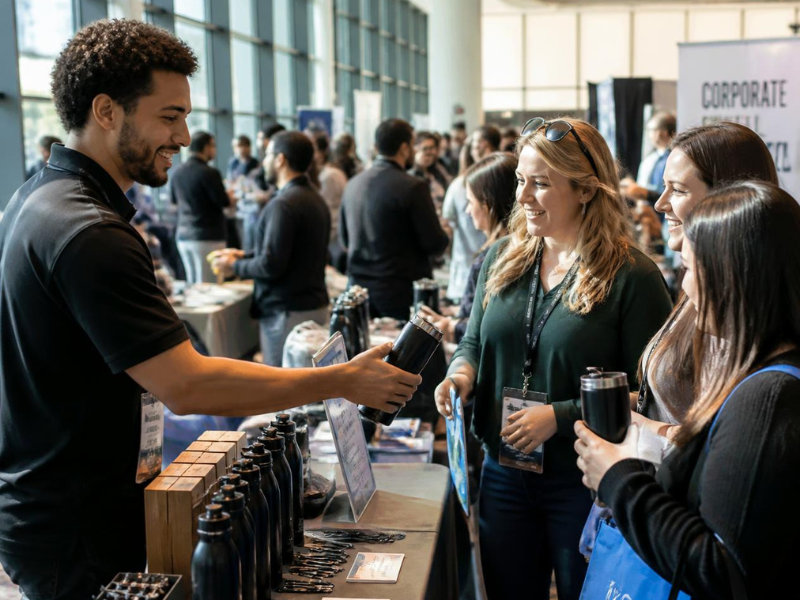
Good examples: branded tumblers or water bottles, wireless phone stands, tote bags with real carry capacity, portable chargers, quality notebooks with a branded pen set.
The psychology here matters. When someone receives a Tier 2 item, they feel like they earned it. That creates a positive association with your brand at the moment they are most engaged.
Tier 3 — VIP Gifts (Give Only to Qualified Prospects)
These are reserved for people who are genuinely likely to buy. Decision-makers, people who have expressed serious interest, or prospects you have been trying to reach for months. These items are memorable enough to start every follow-up conversation you have with them.
- Budget: $25 to $75 per item
- Quantity: 5 to 10 percent of expected booth visitors
- Goal: Relationship building and post-show follow-up leverage
Good examples: premium insulated tumblers, Bluetooth speakers, leather-bound notebooks, branded tech kits, curated gift sets.
When you follow up after the show and reference the item — "hope that speaker has been getting some use" — you instantly differentiate your email from every other generic follow-up they received that week.
How Much Should You Spend on Trade Show Giveaways?
Most exhibitors either way overspend on giveaways or dramatically underspend. Here is a simple formula that gives you a realistic starting point.
- Step 1: Get the expected attendance number from the show organizer.
- Step 2: Estimate the percentage likely to visit your booth. For a 10x10 booth at a 5,000-person show, 5 to 10 percent is realistic — that is 250 to 500 people.
- Step 3: Apply the tier breakdown: 70% Tier 1, 25% Tier 2, 5% Tier 3.
- Step 4: Multiply each tier by its per-item budget.
Example — 400 expected booth visitors:
| Tier | Qty | Per Item | Total |
| Tier 1 (traffic drivers) | 280 | $2.50 | $700 |
| Tier 2 (engagement rewards) | 100 | $15 | $1,500 |
| Tier 3 (VIP gifts) | 20 | $50 | $1,000 |
| Total giveaway budget | $3,200 |
Add 15 to 20 percent buffer for unexpected traffic and damaged items.
As a general benchmark: total giveaway spend should be 10 to 15 percent of your total trade show budget. If you are spending $20,000 to exhibit, $2,000 to $3,000 on giveaways is reasonable and proportional.
The Best Trade Show Giveaways by Category
Most Reliable Everyday Performers
These items have stood the test of time across every industry because they solve a real, daily problem.
- Insulated tumblers and water bottles — The single highest-retention giveaway in the industry. A good tumbler lives on a desk or in a gym bag for years. Every use is a brand impression. Spend enough to get a quality product — cheap tumblers leak and get thrown out.
- Portable phone chargers — A power bank is the ultimate trade show day item. Everyone's phone is dying by 2 PM. The person who gives them a charger is the hero of their day. Budget $15 to $30 for a unit with enough capacity to actually matter.
- Notebooks with a quality pen — Attendees take notes all day. A well-made notebook that does not feel cheap will get used throughout the show and carried home. Pair it with a metal pen, not a plastic one.
- Tote bags — Practical at the show itself. People need something to carry all the materials they collect. A well-made tote with clean, bold branding becomes a walking advertisement on the show floor.
Tech Giveaways That Get Kept
Tech items have the highest retention rate of any giveaway category. When they work well, recipients use them daily.
- Phone stands and grips — Inexpensive, genuinely useful, and always visible on a desk. A branded phone stand is in someone's line of sight for every video call they take.
- Wireless earbuds — High perceived value, but only viable as Tier 3 items due to cost. Reserve these for your most qualified prospects.
- Charging cables (multi-port) — A three-in-one cable that charges multiple device types costs very little and gets used constantly. Strong Tier 1 or Tier 2 option.
- USB hubs — Great for tech, marketing, and SaaS conferences where everyone is running multiple devices from a laptop.
Eco-Friendly Options That Signal Brand Values
Sustainability-focused giveaways have grown significantly as purchasing committees at enterprise companies increasingly factor environmental values into vendor decisions.
- Bamboo or recycled-material notebooks — Same utility as a regular notebook but with a material story your reps can tell during the handoff.
- Reusable straws with a case — Inexpensive, practical, and a clear sustainability signal.
- Seed paper products — Business cards, bookmarks, or notepads made of seed paper that grows into wildflowers when planted. Memorable conversation starter, zero landfill footprint.
- RPET tote bags — Made from recycled plastic bottles. A clear sustainability message built into the product.
Food and Consumable Giveaways
Food draws crowds. The smell of fresh popcorn, coffee, or cookies stops foot traffic better than almost any display. But food giveaways require planning — power access, permits in some venues, and hygiene standards.
- Branded coffee or snack stations — If you can pull it off logistically, a coffee station at your booth is the highest ROI foot traffic driver on any show floor. People queue for coffee. They talk while they queue. Your team can engage them naturally.
- Premium branded chocolate or candy — Individual-wrapped items with your logo. Inexpensive, universally appreciated, and reliably drive Tier 1 traffic when displayed openly.
- Mini hot sauce or specialty condiment sets — A surprisingly effective Tier 2 item in food, restaurant, and consumer goods shows. Niche, memorable, and conversation-starting.
What NOT to Give Away at a Trade Show
Just as important as knowing what works is knowing what to avoid.
- Cheap plastic pens — The ones with the wobbly clip and the ink that runs out in 20 minutes. They signal low quality and get thrown away immediately. If you are going to give pens, spend enough to give ones that write well.
- Generic stress balls — A relic of a different era. Nobody needs a foam ball shaped like your logo. It communicates nothing about your brand except that you did not think very hard about this.
- Items with no connection to your audience — A fishing lure giveaway at a SaaS conference. A USB drive at a medical device show where IT policies block unknown drives. Always ask: would my actual buyer find this useful?
- Oversized items people have to carry — Anything that does not fit in a tote bag or briefcase becomes a burden by hour two of the show. People leave heavy or awkward items at the booth, in a trash can, or at the hotel.
- Cheap food — Stale candy from a bulk bag is worse than no candy. If you are going to do food, do it well.
- Anything that requires explanation to use — Your giveaway should be immediately understood. If you need to explain how the item works, it will not be used.
Industry-Specific Giveaway Ideas
Your audience matters more than the item itself. Here is what tends to work across specific verticals.
- Technology and SaaS: Phone stands, charging cables, premium notebooks, USB hubs, custom laptop stickers, AirTag holders.
- Healthcare and Medical: Hand sanitizer kits, branded stress relievers (the quality kind), reusable water bottles, first-aid kits, branded face masks.
- Finance and Professional Services: Quality pens, leather cardholders, premium notebooks, branded umbrellas.
- Food and Beverage: Branded tumblers, mini hot sauce sets, reusable grocery totes, coffee subscriptions (QR code to a branded landing page).
- Manufacturing and Industrial: Work gloves with logo, multi-tools, flashlights, hard-hat stickers, branded ear protection.
- Retail and Consumer Goods: Branded tote bags, product samples, limited-edition packaging, loyalty codes, reusable shopping bags.
- Education: Notebooks, highlighter sets, branded backpacks (high-value Tier 3), branded USB drives pre-loaded with resources.
How to Use Giveaways to Capture Leads — Not Just Attention
A giveaway without lead capture is just a donation.
The smartest exhibitors tie their giveaways directly to data collection. Here is how the mechanics work:
- Badge scanning for Tier 2 items: After a qualifying conversation, scan the visitor's badge before handing over a mid-range item. Now you have their name, company, title, and contact — all before they walk away.
- QR code contests: Display a QR code at the front of your booth that enters visitors into a drawing for a premium item. Submissions go directly to your CRM. You collect leads from people who did not even speak to your staff.
- Spin-to-win wheels with a form: Physical or digital spin wheels require an email address to spin. Gamified, visible from across the aisle, and a reliable crowd-drawer during slow hours.
- "Earn your swag" demos: Tie a premium giveaway to attending a 5-minute demo. You filter out the freebie-hunters and guarantee a product conversation with everyone who receives a Tier 2 or Tier 3 item.
The goal is for every giveaway above Tier 1 to be connected to a name in your database.
Timing Your Giveaways on the Show Floor
When you give out items matters almost as much as what you give.
- Morning of Day 1: Hold back your best Tier 2 and Tier 3 items. The decision-makers and senior buyers tend to show up later in the day or on Day 2. Do not burn your premium stock on Day 1 rush.
- Midday slumps: This is when a spin-to-win wheel or a visible giveaway drawing creates the most foot traffic. Use your Tier 1 items aggressively during quiet hours to keep the booth active.
- Final hours of the last day: Many exhibitors pack up early. Stay open, use remaining stock openly, and you will capture the late-day wanderers — often including buyers who are doing final-round evaluations.
- Never run out of Tier 1: A booth with nothing to offer becomes invisible. Keep a reserve of your traffic-driver items and replenish throughout the day.
What Is Exhibitorly?
Your giveaway strategy is only one part of what makes a great booth. The other part — the one that draws people in before they ever see your swag — is the booth itself.
Exhibitorly is the leading online marketplace for trade show exhibitors in the United States.
It connects businesses with verified booth builders, exhibit rental companies, and display suppliers across 100+ trade shows nationwide — all in one place.
Instead of researching vendors one by one, you search by show name, booth size, and budget, and connect directly with the right suppliers for your specific event. Whether you need a 10x10 rental, a custom island exhibit, or a modular display that travels across multiple shows, Exhibitorly has the network to match you with the right partner fast.
Exhibitorly is free to use for exhibitors. Find your booth builder at Exhibitorly →