
How to Choose the Right Booth Builder for CES 2027
Choosing the right booth builder for CES 2027 involves more than finding a company with extensive trade show experience or a strong portfolio. Exhibitors should evaluate the builder's specific CES venue experience, production capacity around the January show schedule, rental and custom capabilities, familiarity with CES's EAC process, relevant CES references, comparable portfolio work, pricing structure and change-order policies. It is also important to assess whether the builder understands the exhibitor's objectives and can turn those requirements into an effective booth design. Comparing several builders against the same criteria helps exhibitors find a partner that fits their booth, budget, venue and goals rather than simply choosing a highly ranked or recognisable name.
Search for “best CES booth builders” and you'll get a dozen ranked lists, most of them published by companies that also build booths. Those lists can give you names, but they don't answer the more important question: which builder is actually right for your CES 2027 project?
That decision comes down to more than years in the exhibit industry or an impressive portfolio. CES 2027 spans 12 official venues grouped into three campuses, with venue-specific exhibitor manuals, freight procedures and operational requirements.
If you're already committed to exhibiting, these are the criteria worth using when you compare builders.
CES venue experience isn't one thing
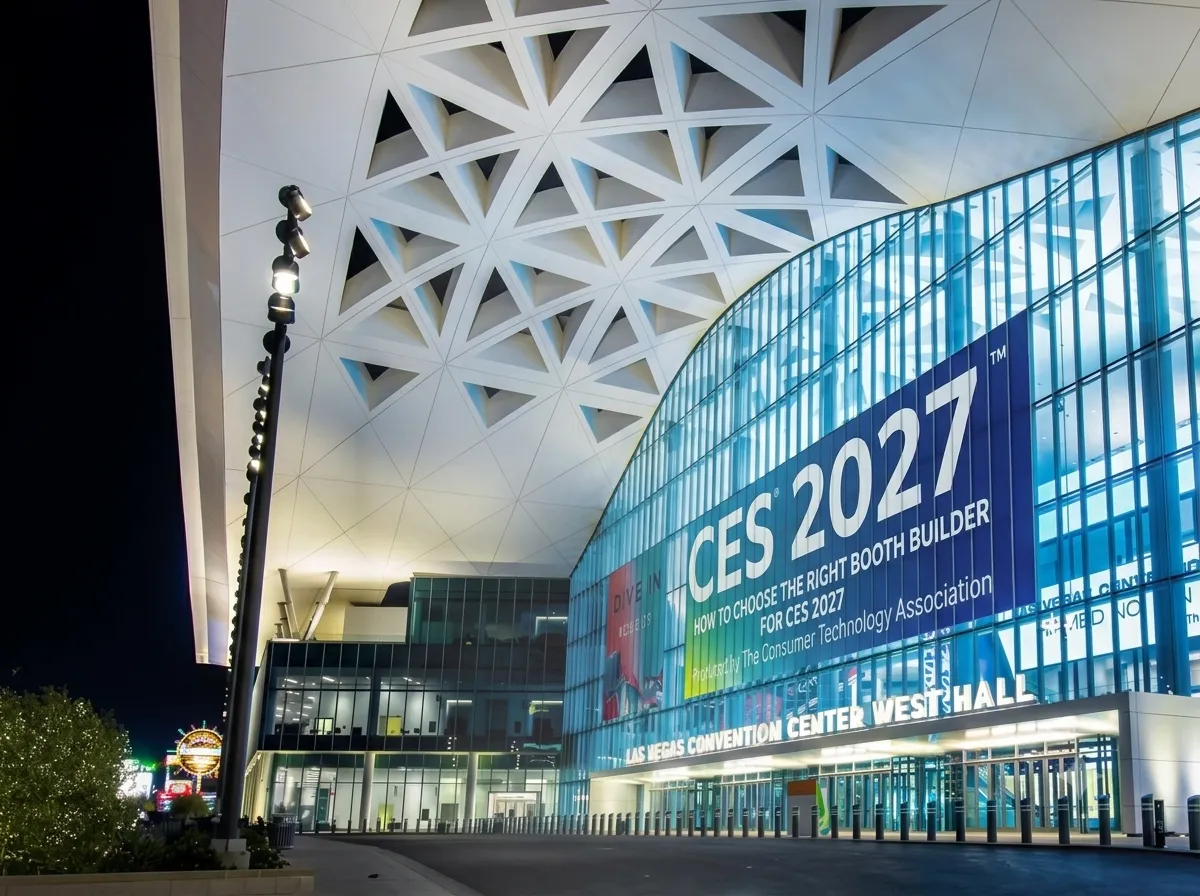
CES 2027 is spread across multiple official venues and exhibit environments, including the Las Vegas Convention Center, Venetian Expo, ARIA and others. Eureka Park, for example, is located within The Venetian Expo rather than being a separate venue. CES publishes venue-specific exhibitor manuals because the planning requirements can differ by location.
That matters when you're choosing a booth builder. A company that has built dozens of booths at the Las Vegas Convention Center isn't automatically going to have the same familiarity with the Venetian's freight procedures, access arrangements or installation requirements.
Ask a prospective builder which CES venue and hall they've actually worked in. Don't settle for “we've done CES many times.” Ask for the year, venue and, ideally, examples of the work.
A specific answer tells you much more than a generic CES logo on a website.
The January production squeeze
CES 2027 runs from January 6–9, 2027, which means your booth has to move through design, approvals, fabrication, shipping and installation immediately around the Christmas and New Year period.
That makes production planning particularly important. A builder can be perfectly reliable for a trade show in June and still struggle with CES if it hasn't planned its January workload and fabrication capacity properly.
Ask:
- When does your CES production schedule lock?
- When do you need final artwork and design approval?
- Where will the booth be fabricated?
- When does it leave the shop for Las Vegas?
- What buffer do you build into the schedule?
- What happens if artwork or specifications change late?
You don't need a builder who promises that nothing will ever go wrong. You need one that can explain what happens when something does.
Don't let the builder decide rental vs. custom for you
A builder who primarily sells rental booths has an obvious incentive to recommend rental. A builder whose business is built around custom fabrication has a different incentive.
That doesn't automatically make either recommendation wrong. It does mean you're not necessarily getting a neutral comparison.
If you haven't already worked through rental vs. custom for CES 2027, make that decision before you start comparing builders.
Then ask each builder a more useful question:
“Based on our booth size, objectives, budget and how often we exhibit, which approach would you recommend, and why?”
A good builder should be able to explain the trade-offs rather than simply selling you the type of booth it happens to build most often.
Make sure they understand CES's EAC process
If you're using an independent contractor rather than CES's official general contractor, you'll need to understand the Exhibitor Appointed Contractor (EAC) process.
CES describes EACs as independent contractors hired by exhibiting companies and provides dedicated EAC information and registration through its 2027 exhibitor resources. CES says EAC registration will open in fall 2026.
This is one of those areas where experience matters because the builder should already know what paperwork, insurance information and registration steps are involved.
Ask the builder:
- Do you regularly work as an EAC at CES?
- Do you handle the EAC registration process?
- What insurance documentation do you require from us?
- What information do you need before the registration deadline?
- Who is responsible for making sure everything is submitted?
You don't want to discover during move-in that the contractor and exhibitor each assumed the other was handling the paperwork.
Ask for CES references, not just trade show references
Years of trade show experience don't automatically mean years of CES experience.
CES has its own planning environment, multiple campuses and venue-specific requirements. Its official exhibitor resources include separate manuals for locations such as ARIA, LVCC, Mandalay Bay, Venetian Expo and Fontainebleau.
So ask for references from CES specifically.
Better still, ask whether they've worked at the venue you're assigned to.
A builder with excellent references from a single-hall show somewhere else isn't necessarily a bad choice. They simply haven't demonstrated experience with the operational complexity you're about to deal with at CES.
Look at the booth, not just the client logos
A long list of recognizable clients looks impressive, but it doesn't necessarily tell you whether the builder is right for your project.
Look at completed booths that are similar to what you're actually planning.
If you're building a 20×20 technology booth with product demonstrations and meeting space, a gallery full of 50×50 brand activations isn't particularly useful. Ask to see examples with comparable:
- Booth footprint
- Level of customisation
- Product display requirements
- AV or interactive technology
- Meeting space
- Visitor flow
- Installation complexity
You're not looking for the prettiest portfolio.
You're looking for evidence that the builder can execute your particular brief.
Also ask what part of the project the builder actually delivered. Some portfolios show work where the builder handled fabrication and installation; others may involve a separate design agency, brand agency or experiential partner.
That distinction matters when you're evaluating what the builder can actually do for you.
Compare the quote, not just the headline price
The cheapest quote isn't necessarily the cheapest booth.
Before comparing two proposals, make sure you understand what each one actually includes. A quote can look dramatically cheaper simply because important costs sit outside the headline figure.
At minimum, ask whether the proposal covers or separately prices:
- Booth design
- Fabrication
- Graphics
- Furniture
- Lighting
- AV and technology
- Installation
- Dismantling
- Freight
- Material handling
- Storage
- On-site supervision
- Changes after design approval
CES itself publishes venue-specific rates and logistics information through its exhibitor manuals, including material handling, installation and dismantling rates.
You don't need every builder to structure its quote identically. You do need enough detail to compare them on an apples-to-apples basis.
Ask how they handle change orders
This is where a low initial quote can become an expensive project.
CES is a large show with detailed rules, venue requirements and a tight installation schedule. If your booth changes after the original scope is approved, you need to know how that change will be priced and managed.
Ask before signing:
“What happens if we need to change something after the design is approved?”
Then ask:
- Is there a standard change-order process?
- Are design revisions included?
- When does fabrication become non-refundable?
- How are rush changes priced?
- Who approves additional costs?
- Will you receive written confirmation before additional work begins?
A builder with a slightly higher initial quote but transparent change-order terms can ultimately be easier to budget for than one with a very low starting price and expensive extras.
Look for a builder who understands your objective, not just your booth
A good booth builder should be asking questions about why you're exhibiting.
- Are you launching a product?
- Trying to generate leads?
- Looking for distributors?
- Hosting pre-booked meetings?
- Demonstrating technology?
- Trying to attract the media?
The booth needs to support that objective.
For example, a company whose primary goal is product demonstrations may need an entirely different layout from one whose CES strategy is built around executive meetings. A builder should be able to challenge the brief when something doesn't make sense rather than simply turning your list of requirements into a rendering.
Ask:
“Based on what we're trying to accomplish at CES, what would you change about our initial booth brief?”
The answer can tell you a lot about whether you're dealing with a strategic partner or simply a fabricator taking an order.
Compare at least a few builders before deciding
Once you know your requirements, don't send the same vague request to one builder and accept the first proposal that comes back.
Give several relevant builders the same basic brief:
- CES venue and booth number, if available
- Booth dimensions
- Rental or custom preference, if already decided
- Product or service being exhibited
- Primary objectives
- Required demonstrations or technology
- Meeting-space requirements
- Target budget
- Important deadlines
Then compare not just the price, but how each builder responds to the brief.
- Does one immediately understand the visitor journey?
- Does another ask better questions?
- Does one identify a logistical issue you hadn't considered?
- Does one give you a realistic timeline while another simply promises to make it work?
Those differences can be more important than a few thousand dollars on the initial quote.
Where this actually gets decided
None of this can be reliably answered by looking at a builder's homepage for five minutes. You need to compare actual companies against the requirements of your CES project.
That's where Exhibitorly can make the research easier. Instead of starting with a generic list of booth builders and contacting them one by one, you can use Exhibitorly to find and compare vetted exhibit builders for CES 2027 based on their portfolios, experience and project requirements.
The goal isn't to find the builder with the biggest client list or the flashiest booth gallery. It's to find the builder that has the right CES experience, the right capabilities and the right approach for your particular booth.
For CES 2027, that distinction matters.