SEG Backlit Trade Show Booths: The Complete Lightbox Guide
A SEG backlit trade show booth is the fastest way to make a small footprint look premium. This guide covers what SEG lightboxes cost, which fabric and LED specs matter, where backlit walls underperform, and how to brief a builder so your booth ships light and sets up in under an hour.
SEG Backlit Trade Show Booths: The Complete Lightbox Guide
Walk any US show floor and the booths that read from fifty feet away have one thing in common: the graphics are lit from behind, not from in front. A SEG backlit trade show booth is the cheapest way to get that effect, and it is why backlit fabric has replaced rigid panels as the default for exhibitors working with 100 to 400 square feet.
This guide covers what a SEG lightbox actually costs, which fabric and LED specs are worth arguing about, where backlit walls disappoint, and how to brief a builder so you do not overpay.
What a SEG Backlit Trade Show Booth Actually Is
SEG stands for silicone edge graphic. A printed polyester panel has a thin silicone strip sewn around its border, and that strip presses into a channel milled around an aluminum frame. The fabric pulls drum-tight, the frame disappears behind it, and you get a wall with no visible seams, screws, or trim.
Make that frame deep enough to hold an LED array behind a diffuser, and the same system becomes a seg lightbox trade show booth. Light passes through the fabric instead of bouncing off it, which is what kills the shadows and hot spots that clip-on arm lights create.
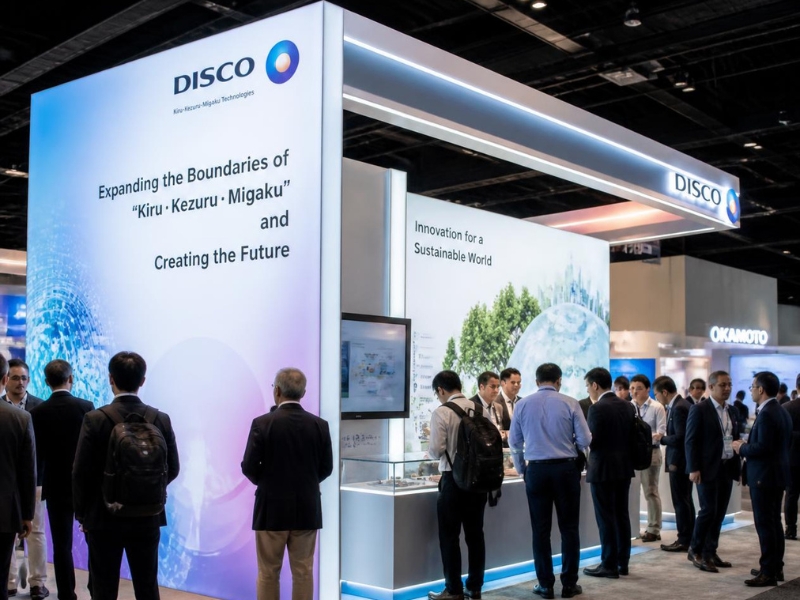
The practical consequence: a 10ft backlit trade show booth wall packs into one or two wheeled cases, weighs under 100 lbs, and two people can build it in under an hour without tools.
Why Backlit Beats Front-Lit
Convention halls are lit for safety, not for your brand. The ambient light is flat, grey, and roughly the same everywhere, which means a front-lit booth competes with 1,200 other booths under identical conditions. A lit panel does not compete, it contrasts.
Three things change when you go backlit:
- Read distance. Backlit type stays legible from across an aisle where printed vinyl goes muddy.
- Colour depth. Transmitted light makes saturated colours look richer than reflected light ever will.
- No shadow on staff. Arm lights cast hard shadows onto whoever stands at the counter. Backlighting does not.
The upcharge over a plain SEG wall usually lands between 30% and 50%. In the under-$5,000 range there is no other single upgrade that changes the booth as visibly, which is why most builders now quote trade show booth lighting as backlit by default rather than as an add-on.
SEG Lightbox Sizes and What They Cost
| Configuration | Typical use | Buy | Rent (per show) |
|---|---|---|---|
| 8ft backlit wall | Tabletop / small inline | $2,800-$4,500 | $1,100-$1,800 |
| 10ft backlit wall | Standard 10x10 back wall | $3,500-$6,500 | $1,400-$2,400 |
| 20ft backlit wall | 10x20 inline back wall | $6,500-$12,000 | $2,600-$4,500 |
| Backlit tower (3-4ft wide) | Corner accent, island anchor | $2,000-$4,000 | $800-$1,600 |
| Double-sided hanging lightbox | 20x20 island overhead | $8,000-$20,000 | $3,500-$8,000 |
Those figures cover frame, fabric, and LEDs. They exclude drayage, electrical, rigging for hanging units, and the fabric reprint you will want before a rebrand.
Fabric, Frames, and LEDs: What to Specify
Most quotes look identical on the surface. The differences that matter are buried in three specs.
Fabric. Ask for dye-sublimated polyester rated for backlit use, typically 200-260 gsm with a blockout or light-diffusing backing. Standard front-lit fabric used behind LEDs will show the array as visible stripes.
Frame depth. Shallow frames are cheaper and lighter, but they are also where uneven light shows. Below about 80mm you need a very good diffuser to avoid hot spots. Between 100mm and 160mm is the safe range for a single-sided wall.
LEDs. Specify 5000-6500K for neutral white, ask whether the array is edge-lit or matrix, and insist on seeing a lit sample at your frame depth. A builder who will not show you a lit sample is telling you something.
One more question worth asking: is the extrusion a standard profile or proprietary? A proprietary frame means every future reprint has to come from that one builder. A standard profile means you can shop the reprint.
Where SEG Backlit Booths Underperform
Backlit fabric is not the answer to everything, and a builder who says it is has one product to sell.
- Heavy shelving and product weight. SEG frames carry graphics, not load. Anything you hang has to go on a separate structure.
- Storage and lockable counters. Fabric walls give you no enclosed space. You still need millwork for that.
- Very large islands. On a 20x20 or larger, SEG handles the vertical surfaces well but cannot create rooms, so most island builds mix SEG with custom construction.
- Outdoor and high-humidity venues. Tension and print behave less predictably outside a climate-controlled hall.
Shipping, Setup, and Reuse
The economics of SEG are mostly logistics economics. A 10ft backlit wall ships in one or two cases against a pallet for a comparable rigid build, which cuts drayage, usually the least predictable line on a show invoice. Setup drops from a half-day crew call to a two-person hour, which matters most at union venues where labour is billed against a minimum call.
Reuse is where the system pays for itself. The frame and LEDs last for years. A fabric reprint for a 10ft wall runs roughly $600-$1,200, so a full visual refresh costs a fraction of a rebuild. Exhibitors running four or more shows a year typically recover the backlit upcharge inside the first two.
Get Quotes on Your SEG Backlit Booth
Quotes for the same backlit wall routinely differ by 30-50% between builders, mostly on fabric grade, frame depth, and whether LEDs are included or quoted separately. Ask every builder for a line-item quote covering frame, fabric, LEDs, cases, and reprint cost, or you cannot compare like for like.
Exhibitorly matches you with three vetted builders who quote your exact configuration, with free design concepts and no cost to exhibitors. You compare specs and prices side by side and keep whichever partner fits.