

The Complete Trade Show Checklist for Exhibitors (2026)
A complete trade show checklist runs across four phases: strategy (3 to 2 months before), preparation (1 month before), the event itself, and post-show follow-up (the first week after). CEIR research shows 70 percent of attendees plan their show schedule in advance, and pre-booked meetings convert at 3 to 5 times the rate of cold booth conversations, which is why the strategy phase matters as much as the booth itself. Corner and aisle booth positions generate 20 to 30 percent more foot traffic, and teams that run daily debriefs during multi-day shows capture 20 to 40 percent more qualified leads than teams that don't. Keep reading for the full phase-by-phase trade show checklist, a compressed printable version, and the mistakes that quietly cost exhibitors the most leads.
Most exhibitors show up with a booth, a banner, and a stack of business cards, and not much else. The problem isn't effort. It's that trade show prep usually starts with logistics (shipping, setup, swag) instead of strategy, which is exactly backwards.
Roughly 70 percent of trade show attendees plan their schedules before they arrive, according to research from CEIR (Center for Exhibition Industry Research). If your prospects are planning months ahead, a trade show checklist that starts the week before the show is already too late. This guide breaks the process into four phases, from strategy work months out to the follow-up that happens after you're home, so nothing falls through the cracks.
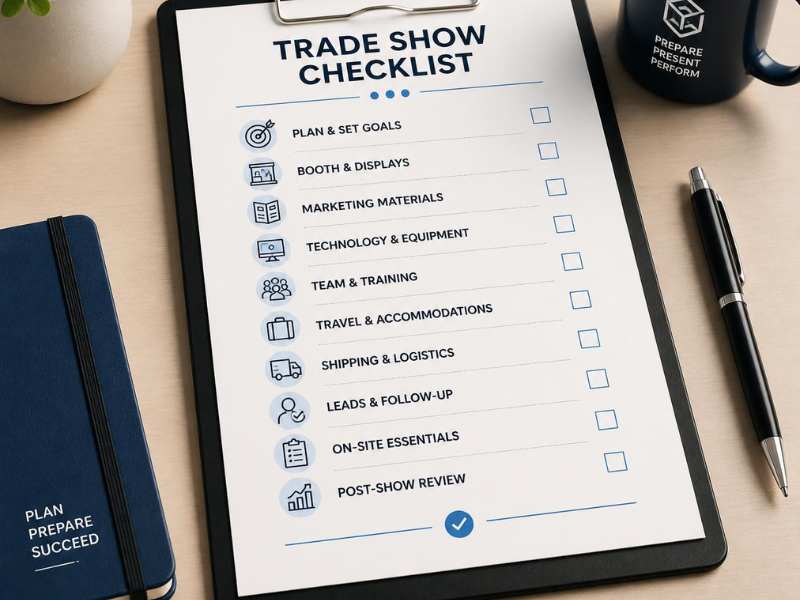
The Trade Show Checklist Timeline: Four Phases
A trade show isn't a single event, it's a short campaign with four distinct phases, each with its own checklist. Skipping a phase weakens every phase that follows it.
- Phase 1: Strategy (3 to 2 months before). Define goals, budget, and target accounts.
- Phase 2: Preparation (1 month before). Brief the team, test technology, finalize logistics.
- Phase 3: At the event. Execute the plan, capture leads, debrief daily.
- Phase 4: Post-show (first week after). Follow up, verify data, measure results.
Mapping these four phases against your specific show's dates is the fastest way to turn a vague trade show timeline into a working schedule. Each phase gets its own detailed checklist below.
Pre-Show Checklist: Strategy, 3 to 2 Months Before
This is the part of the pre-show checklist most exhibitors skip entirely, and it's the one that determines whether the rest of the show performs. If your trade show timeline only starts a few weeks out, this strategy phase is almost certainly the piece that got cut.
Set clear, measurable goals. "Generate leads" isn't a goal. A real goal names a target lead count, a target same-day follow-up rate, and a target pipeline value. Vague goals produce vague results.
Build your budget with the hidden costs included. Booth space and travel are the obvious line items. The costs that quietly erode ROI are staff time, opportunity cost of deals not worked while traveling, and post-event processing time. CEIR's Exhibition Spending Report found that 38 percent of exhibitor budgets go toward costs that don't directly generate leads, which makes a detailed budget worth the extra hour it takes to build. Our trade show budget planning guide covers the full category breakdown if you haven't built yours yet.
Research and prioritize target accounts. Attendee lists are usually available from the event organizer weeks in advance. Cross-reference the list against your ideal customer profile and identify the 20 to 30 accounts you most want to meet, then reach out before the show to book time. Pre-booked meetings convert at 3 to 5 times the rate of cold booth conversations, making this one of the highest-return items on the entire trade show checklist.
Reserve your booth location early. Corner booths and aisle positions generate 20 to 30 percent more foot traffic than mid-row spots. If you have any input on placement, this is worth pushing for.
Choose your booth builder if you're not exhibiting with an existing setup. Comparing a few options before committing gives you leverage on pricing and design. Our guide to hiring a trade show booth builder walks through how to vet contractors at this stage.
Trade Show Planning Checklist: Preparation, 1 Month Before
With strategy locked, this phase of the trade show planning checklist turns the plan into something your team can actually execute. Treat this as the middle third of your trade show timeline, where strategic decisions become concrete tasks with owners and deadlines.
Brief the booth team. Every person working the booth should know the target customer profile, the qualifying criteria that separate a hot lead from a warm one, and the pitch structure. The most common preparation mistake is assuming the team already knows the workflow. Run a dry-run walkthrough at least once before the show.
Set up and test lead capture technology. Badge or card scanning, CRM integration, and any conversation-capture tools should be configured and tested in advance, including offline mode, since trade show floors regularly have unreliable wifi.
Evaluate your booth and refresh what needs it. Outdated graphics or a tired display can undercut an otherwise solid trade show checklist. Sometimes new graphics or accessories refresh an existing exhibit without the cost of a full rebuild. If you're finalizing setup logistics at this stage, our booth setup and install-day guide covers union labor rules and typical install timelines by booth size.
Confirm shipping deadlines and show floor services. Lock in electrical, internet, and any other services ordered through the show's general contractor while early pricing is still available.
Finalize giveaways and promotional items. Decide what you're handing out and to whom before you're standing at the booth deciding on the fly. Our guide to trade show giveaways covers a tiered spending framework that keeps this category from turning into wasted budget.
Pack an emergency kit. Tape, zip ties, extension cords, chargers, and basic cleaning supplies solve most on-site problems without a scramble.
Promote your attendance. Announce you're exhibiting through email, LinkedIn, and your website before the show opens. Prospects who already planned to stop by convert at a noticeably higher rate than walk-up traffic.
Trade Show Booth Checklist: At the Event
Execution day. The team is briefed, the technology is tested, the booth is built. This is where the trade show booth checklist shifts from planning documents to a live, minute-by-minute routine.
Run the capture workflow consistently. For every meaningful conversation: scan the badge, note the context, and queue a follow-up while the conversation is still fresh. Waiting until after the show to work through a stack of badges is where most trade show ROI quietly disappears.
Assign leads in real time. Don't wait until the show ends to route leads to the right rep.
Run a daily debrief. A 10-minute end-of-day check-in covering lead count, common questions, and staff energy compounds across a multi-day show. Teams that debrief daily capture 20 to 40 percent more qualified leads than teams that skip this step.
Manage booth energy. A multi-day trade show is a marathon. Rotate staff every 2 to 3 hours, keep water and snacks nearby, and give the team a quiet space for quick breaks. A tired rep gives a worse pitch and forgets to capture context.
Track your daily numbers against your target. If you're two days in and well behind your lead goal, that's information you can act on immediately, not something to discover after the show closes.
Post-Show Checklist: The First Week After
The trade show checklist doesn't end when the booth comes down. This post-show checklist phase determines whether the leads you captured turn into pipeline, and it's the final stretch of the trade show timeline that most exhibitors rush through.
Follow up on any remaining leads within 48 hours. Response rates drop sharply after the second day post-show, so speed matters more here than almost anywhere else in the process.
Verify your CRM data. Every captured lead should have full contact information, conversation context, a qualification tag, and an assigned rep. Gaps here are process gaps worth fixing before the next show.
Calculate your results. Total leads captured against target, same-day follow-up rate (aim for 90 percent or higher), response rate on follow-ups, and pipeline generated within 30 days all belong in a short post-show report.
Document lessons learned. A one-page retrospective on what worked and what didn't makes the next show's checklist sharper than this one.
The Printable Trade Show Checklist
Here's the condensed version to print and bring with you.
3 to 2 months before: Goals defined. Budget set with hidden costs included. Target accounts identified and outreach started. Booth location reserved. Booth builder selected if needed.
1 month before: Team briefed on qualifying criteria and workflow. Lead capture technology tested, including offline mode. Booth graphics reviewed and refreshed if needed. Shipping and show floor services confirmed. Giveaways finalized. Attendance promoted.
At the event: Capture workflow running consistently. Leads assigned in real time. Daily debriefs happening. Staff rotation managed. Daily numbers tracked against target.
First week after: Remaining leads followed up within 48 hours. CRM data verified. Results calculated. Retrospective documented.
Common Trade Show Checklist Mistakes to Avoid
A few patterns show up repeatedly in exhibitors who come home disappointed with their results:
Starting the trade show checklist with logistics instead of strategy, which means the booth looks great but nobody agreed on what a qualified lead actually looks like.
Skipping pre-show outreach entirely and relying on walk-up traffic, which leaves the highest-converting activity on the table before the show even starts.
Treating lead capture as a post-show task instead of a live, at-the-booth workflow, which is how warm conversations turn into a forgotten stack of badges.
Running a multi-day show without daily debriefs, missing the pattern-spotting and energy management that daily check-ins provide.
Letting follow-up slip past 48 hours, right when response rates are dropping fastest.
Upcoming Shows Worth Building a Checklist Around
If you're exhibiting at a fall show, a couple of events coming up are worth mapping your checklist timeline against now. AREMA 2026 runs September 12-18 in Kansas City, and the technical, specification-driven audience there rewards exhibitors who prepare detailed product documentation well before move-in. NRPA Annual Conference 2026 runs September 29 through October 1 in Philadelphia, a useful reminder that the strategy phase of your checklist should always start with who's actually attending, since a parks-and-recreation audience needs a very different pitch than an engineering-focused one.
Whichever show you're prepping for, comparing vetted booth builders through Exhibitorly is a good first step to check off your strategy-phase checklist.
What Is Exhibitorly?
Exhibitorly is an American marketplace that helps exhibitors find the right booth builder for a trade show. Instead of contacting builders one by one, you submit a single request with your show, your booth size, your timeline, and your budget. Exhibitorly matches that request with a small number of vetted builders who have real experience at that show and venue, not every builder on the platform.
Builders apply to join and get reviewed before approval, so you're only hearing from companies with a track record of delivering. You compare their designs and pricing side by side, and you decide who to work with. There's no obligation, and searching shows or submitting a quote request costs nothing.
Checking "find a booth builder" off your trade show checklist? Compare vetted exhibit builders on Exhibitorly and get quotes built around your exact show and timeline. Read the full platform guide for a closer look at how the matching process works.