

10x10 Trade Show Booth: Designs, Costs & Layout Ideas (2026 Guide)
A 10x10 trade show booth is a 100-square-foot inline space, and it is the size most exhibitors start with. In 2026, a portable pop-up or fabric display for that space typically costs about $580 to $2,600 to buy. Modular and backlit kits usually run $1,700 to $10,000 or more. Custom builds start around $8,000, and turnkey rentals run about $3,000 to $14,000 per show, depending on what's included. This guide covers those costs, the height rules that limit every 10x10 design, what fits in the space, and six layouts that work.
What is a 10x10 trade show booth?
A 10x10 trade show booth is a linear (inline) exhibit space 10 feet wide and 10 feet deep, set in a straight row with neighbors on both sides and one open side facing the aisle1. That gives you 100 square feet. A corner booth is the same 10x10 linear space at the end of a row, open to two aisles, and the same linear rules apply1.
Because you share walls with neighbors, the show limits how tall your display can be and where you can put tall items. Those rules shape every 10x10 booth design, so we cover them in their own section below.
How much does a 10x10 trade show booth cost?
The honest answer depends on two choices: the booth type and whether you buy or rent. The table below pulls 2026 list prices and published ranges from several vendors. Treat them as typical ranges, not quotes.
| Booth type | Buy (typical range) | Rent (typical range, per show) | Setup | Best for |
|---|---|---|---|---|
| Pop-up display (fabric or hook-and-loop) | About $580–$1,7002–4 | Rarely listed as a stand-alone rental; most vendors sell these | Minutes, no tools4 | First shows, tight budgets, tabletop-to-floor upgrade |
| Tension fabric backwall or kit | About $730–$2,6002, 3, 5, 6 | Rarely listed as a stand-alone rental | 10–20 min, one person6 | Clean graphics, light shipping, frequent travel |
| Modular or backlit kit | About $1,700–$10,000+3, 4, 6, 7 | $3,000–$7,500 turnkey (structure, graphics, setup and teardown often included)8, 9 | Tool-free for most kits4, 6 | Repeat exhibitors who want a built look |
| Custom build or custom-designed rental | $8,000–$20,000+6, 8 | About $7,000–$14,000 for custom-designed, fixed-price rental packages10, 11 | Installed by the builder's crew | Brands with a strong visual identity or complex demos |
A few notes on reading the table:
- Vendor list prices vary with graphics, counters, lighting and cases. A 10x10 modular kit with SEG graphics, counter and a full-size storage closet lists at about $28,570 at one retailer2, far above the typical band.
- Rental prices include very different things. Some include design, graphics, shipping and installation11. Others quote the hardware only, with graphics, carpet, drayage and electrical priced separately12, 13.
- Rentals often cost about one-third of the purchase price, according to one rental supplier12. That is a useful rule of thumb for the rent-or-buy math below.
Booth space and show costs come on top
The exhibit is only one line in your budget. GES, a major general service contractor, puts booth space in exhibit halls at an average of $100 to $150 per square foot. That makes the space alone for a 10x10 about $10,000 to $15,000 at a major show14. Rates vary widely by show; one vendor cites about $21 per square foot on the low end15.
GES also offers a ballpark: total show costs often run about three times the cost of the space14. So a $12,000 space suggests a full show budget near $36,000 once you add the exhibit, shipping, drayage, electrical, travel and promotion.
Should you rent or buy a 10x10 booth?
Use the one-third rule as a starting point. If a rental costs about a third of buying12, buying tends to pay off once you plan to use the same booth at three or more shows. Pop-up and fabric displays cost so little that most exhibitors simply buy them.
Rent when you exhibit once or twice a year, fly to shows far from where you store things, or want a custom look without owning it. Buy when your show calendar is steady and your message won't change much. Compare trade show booth rental options with a purchase quote before you decide.
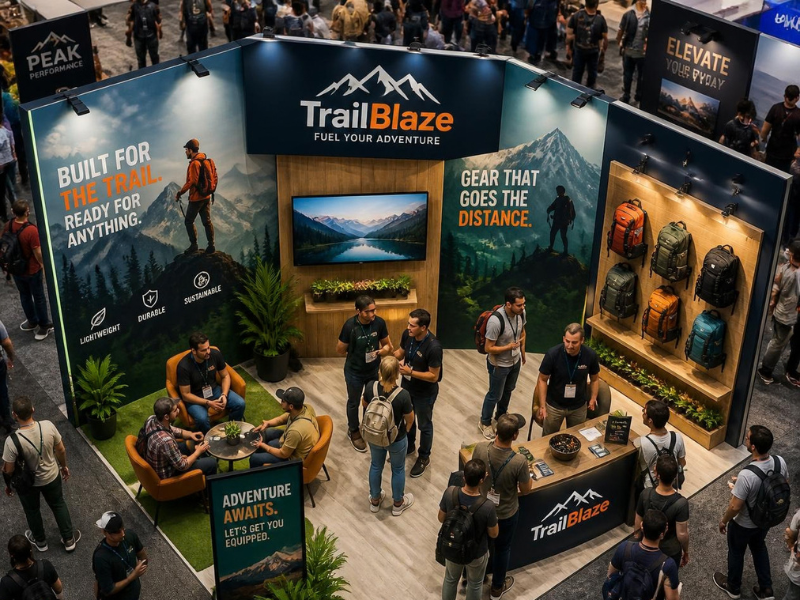
10x10 booth design options
Every 10x10 booth design falls into one of four families. Each trades off cost, looks and setup effort.
10x10 pop up booth
A pop-up uses a folding frame that expands in one piece, then takes fabric or hook-and-loop panels. Vendors describe setup in minutes with no tools4. It is the lowest-cost way to fill a 10-foot back wall, and some kits ship in a case that converts to a branded counter6.
Tension fabric displays
Tension fabric uses a pole frame with a zippered, dye-sublimated fabric graphic pulled over it. One vendor lists toolless, one-person assembly in 10 to 20 minutes6. Fabric graphics pack small and ship light, which matters if you exhibit often. For more on portable options, see our guide to portable pop-up trade show displays.
Modular and backlit booths
Modular systems use aluminum extrusions that snap together with SEG (silicone edge graphics) fabric panels. Backlit versions add LED lighting inside the frame6. They look closer to a custom build, add shelving, monitor mounts and closets, and can be extended to a 10x20 with extra sections6. See how modular trade show booths can be reconfigured across booth sizes.
Custom builds
A custom 10x10 is designed from scratch by a builder, often with wood or metal fabrication, integrated counters and specialty lighting. It costs the most and usually needs a builder's crew for installation. It makes sense when your booth has to hold a product demo or match a brand standard that kits can't meet.
10x10 booth rules: height and line of sight
Most US shows base their booth rules on the IAEE Guidelines for Display Rules and Regulations. For linear booths like a 10x10, the key rules are1:
- Back wall height: a maximum of 8 feet is generally specified.
- Line of sight: the 8-foot height is allowed only in the rear half of the booth. Everything in the front half, toward the aisle, is limited to 4 feet. In a 10x10, that means the front 5 feet.
- Corner booths: a 10x10 on the end of a row follows the same linear rules.
- No hanging signs: inline, corner and perimeter booths don't qualify for hanging signs and graphics.
- Lighting: lights should point into your own booth, not onto neighbors or the aisle.
Two practical warnings. First, your show's exhibitor manual wins over the IAEE guidelines, so check it before you order anything. Individual shows can set their own limits.
Second, not every display sold for a 10-foot space fits these rules. One major manufacturer lists a 10-foot wide by 10-foot high fabric backwall5. That is 2 feet over the typical 8-foot limit for a linear booth, so confirm height before you buy. A tall banner stand or tower placed at the front corner can also break the 4-foot rule.
What fits in a 10x10 booth
Plan for two staff. A common staffing rule of thumb gives each representative about 50 square feet, which puts two people in a 10x1016. One size guide adds that a 10x10 holds two staff plus two to four visitors comfortably15.
For furniture and fixtures, the same guide suggests one backdrop, one counter and one small stand or banner15. In practice, that usually means:
- A 10-foot back wall (pop-up, fabric or modular) up to 8 feet tall
- One counter or kiosk, kept under 4 feet if it sits in the front half
- One monitor, either mounted on the back wall or on the counter
- One small extra: a literature stand, a product plinth or a pair of stools
A common mistake we see is packing a 10x10 with a table across the front. It blocks the aisle side, turns staff into a barrier and leaves visitors no room to step in.
6 layout ideas for a 10x10 booth
Each of these layouts keeps tall items in the rear half and leaves room to step in off the aisle.
- Back wall plus corner counter. Put the counter at one front corner, angled toward traffic flow. The center stays open, so visitors can step in and read the back wall.
- Demo-forward. Place a low product table or plinth near the aisle (under 4 feet) and keep the back wall to one clear message. This works for hardware, packaging and food products.
- Monitor wall. Mount a screen at eye level on the back wall and run a short loop or live demo. Staff stand to the side, not in front of it.
- Meeting nook. Swap the counter for a high-top table and two stools in one rear corner for booked meetings. Use a lockable kiosk for storage.
- Corner booth L-shape. If you have a corner, add a short side wall along your neighbor's side and face your graphics toward both aisles. Keep the side wall at 4 feet or less in the front half.
- Backlit single message. Use a backlit back wall with one headline, your logo and one proof point. Keep the floor almost empty so the light carries the booth.
When to size up to a 10x20
A 10x10 is right for lead capture, brand presence and simple demos with one or two staff. Size up when you need a separate demo and meeting area, more than two people working the booth, or products too large for a counter.
A 10x20 doubles your space to 200 square feet and roughly doubles space costs. It still follows the same linear rules. Compare the two in our 10x20 trade show booth guide, or see every standard size in our trade show booth sizes guide.
Planning a bigger island space? See our 20x20 trade show booth guide.
Next step: get 10x10 booth quotes you can compare
Start with your show's exhibitor manual, set a budget that covers space as well as the booth, and pick the booth type that fits how often you exhibit. Then get real numbers. Prices for the same 10x10 can vary widely, so compare proposals side by side before you commit.
Related guides
- Trade Show Booth Sizes: 10x10 vs 10x20 vs 20x20
- Best Trade Show Lighting Setups for Every Booth Size
- Trade Show Furniture and Flooring Buyer's Guide
- 20x20 Trade Show Booth: Island Booth Costs, Rules & Designs
Sources
- IAEE, Guidelines for Display Rules and Regulations (2019 North American Update)
- Displays2go, 10' x 10' Trade Show Displays
- Westshade, How Much Does a 10x10 Trade Show Booth Cost in 2026?
- Displayit, 10x10 Trade Show Booths & Displays
- Orbus, 10' Formulate Tension Fabric Displays
- Infinity Exhibits, 10x10 Trade Show Booths
- FramePlus Display, How Much Does a 10x10 Trade Show Booth Cost?
- Steadfast Displays, How Much Does a Trade Show Booth Cost in 2026?
- Impact Displays, Trade Show Booth Cost in 2026
- Exhibit Experience, Trade Show Exhibit Cost
- Pure Exhibits, Trade Show Booth Rental Cost 2026
- Tradeshowdirect, Rental Trade Show Displays
- Iconic Displays, 10x20 Trade Show Rentals: Pro Costs Explained
- GES, Exhibitor's Guide to Trade Show Budgeting
- PRINTDRILL, 10x10 vs 10x15 vs 10x20 Booth Size Guide
- Trade Show Advisor, Trade Show Staffing Formula