

How to Calculate Trade Show ROI (And What Counts As a Good Return)
Trade show ROI is calculated as (Revenue Generated minus Total Costs) divided by Total Costs, multiplied by 100. A healthy trade show ROI typically falls between 100 and 300 percent, meaning $2 to $4 back for every dollar spent, while top performers hit 400 percent or higher and first-time exhibitors should expect 50 to 100 percent while they refine their approach. Getting an accurate number requires tracking both hard costs (booth, shipping, travel) and soft costs (staff time, opportunity cost), plus feeding in metrics like lead qualification rate and cost per lead. Most exhibitors underestimate their true costs by ignoring the soft side, which skews the calculation before it even starts. Keep reading for the full formula breakdown, a worked example, and the benchmark numbers that tell you whether your last show actually performed.
Most exhibitors can tell you what a trade show costs. Far fewer can tell you what it returned. According to research cited by EC Exhibits, 84 percent of exhibitors struggle to accurately measure their event marketing returns, and only 34 percent of businesses have a formal trade show ROI tracking system in place, per CEIR (Center for Exhibition Industry Research).
That gap matters because trade shows aren't small line items. The average mid-size company spends roughly $250,000 a year on trade show participation. This guide breaks down the trade show ROI formula, the metrics that feed into it, and what a genuinely good return looks like, so your next post-show report is based on numbers instead of a gut feeling. If you've been meaning to start calculating trade show roi properly instead of estimating it after the fact, this is the framework to use.
For a deeper look at how rental strategy specifically affects returns, our guide on rental exhibit packages and trade show ROI covers the Las Vegas market in more detail.
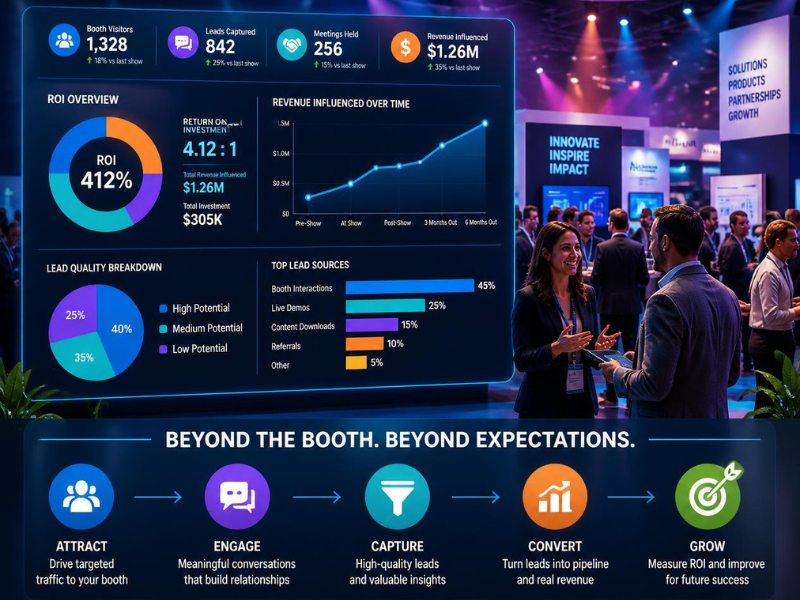
The Trade Show ROI Formula
The core trade show ROI formula is straightforward:
ROI = (Revenue Generated − Total Costs) ÷ Total Costs × 100
If you spent $50,000 on a trade show and generated $200,000 in attributable revenue, your trade show ROI is 300 percent, meaning you generated $3 for every $1 spent.
The formula itself is simple. What trips up most exhibitors is what goes into "Total Costs" and how "Revenue Generated" actually gets attributed, which is where the rest of this guide focuses. Calculating trade show roi accurately depends far more on getting those two inputs right than on the arithmetic itself.
What Counts as a Good Trade Show ROI
Benchmarks give the raw percentage meaning. A healthy trade show ROI generally falls in the 100 to 300 percent range, or $2 to $4 generated per dollar spent. Top-performing exhibitors clear 400 percent or higher through disciplined pre-show planning and fast follow-up. First-time exhibitors should expect a lower 50 to 100 percent return while they refine targeting, staffing, and follow-up processes, and shouldn't read a modest first-show number as a failure.
Most exhibitors see the full trade show ROI materialize 6 to 12 months after the event, not immediately, since B2B sales cycles routinely extend beyond the show itself. Enterprise deals can take up to 18 months to close. Setting monthly checkpoints to track lead progression keeps you from writing off a show too early, before its pipeline has had time to mature.
Hard Costs vs. Soft Costs: What to Include in Your Total
An accurate trade show ROI calculation depends on capturing the full cost side, not just the obvious line items.
Hard costs are direct, easily measured expenses: booth space rental (commonly $5,000 to $50,000 depending on size and show), exhibit design and construction, shipping and drayage, marketing materials, and travel and accommodations. Our trade show budget planning guide breaks down each of these categories with typical percentage allocations if you're building this out for the first time.
Soft costs are harder to quantify but just as real: staff time and wages for the show, pre-show planning hours, post-show follow-up activities, training and preparation time, and lost productivity from staff away from their regular duties. Exhibitors who skip soft costs routinely miss close to 40 percent of their true trade show investment, which inflates their calculated ROI and hides the categories actually worth optimizing.
Booth-related giveaways and promotional spend belong in the hard cost column too. Our guide to trade show giveaways covers a tiered budget framework that keeps this category proportional to the rest of your spend.
Key Metrics That Feed Into Your Trade Show ROI
Trade show ROI isn't just one number at the end. It's built from several metrics tracked throughout the process.
Lead qualification rate is the percentage of booth contacts who actually match your ideal customer profile. Industry average sits at 25 to 30 percent, while top performers reach 40 to 60 percent through better pre-show targeting and staff briefing.
Cost per lead (CPL) is your total show expense divided by qualified leads generated. This is one of the clearest signals of exhibiting efficiency, and the gap between average and top-tier performance is significant.
| Metric | Industry average | Top performers |
|---|---|---|
| Lead qualification rate | 25-30% | 40-60% |
| Lead-to-opportunity rate | 15-20% | 30-40% |
| Cost per lead | 250 | 125 |
| Sales conversion rate | 8-12% | 18-25% |
Qualified trade show leads convert at rates roughly 30 percent higher than cold outreach, which is part of why exhibiting remains worth the investment even at average performance levels. The gap between average and top-performer numbers in this table is almost entirely explained by pre-show goal setting and post-show follow-up speed, not booth size or budget.
Trade Show ROI Calculator: A Simple Worked Example
Here's how the trade show ROI formula plays out with real numbers, using a mid-size exhibitor as an example. Run your own numbers through the same trade show ROI calculator logic below and swap in your actual costs and results.
Total costs: $45,000 (hard costs: booth, shipping, travel, materials) plus $15,000 (soft costs: staff time, planning hours) equals $60,000 total investment.
Leads captured: 200 total booth contacts, with a 35 percent qualification rate producing 70 qualified leads. That's a cost per lead of roughly $857, calculated as $60,000 divided by 70.
Revenue generated: Of those 70 qualified leads, a 12 percent sales conversion rate over the following 6 to 12 months closes 8 deals at an average value of $22,500 each, producing $180,000 in attributable revenue.
Trade show ROI: ($180,000 − $60,000) ÷ $60,000 × 100 = 200 percent.
That result sits comfortably in the healthy 100 to 300 percent range, though the cost per lead of $857 is well above the industry average of 250, signaling that tightening pre-show targeting or booth traffic could meaningfully improve the number next time without spending more.
Why Most Exhibitors Underestimate Their Trade Show ROI
A few consistent mistakes distort trade show ROI calculations before the math even starts.
Incomplete cost tracking. Companies that skip lead sources, conversation quality, and cost-per-lead tracking waste an average of 38 percent of their exhibit budget on strategies that aren't working, without ever knowing it.
Slow or missing follow-up. Roughly 80 percent of trade show leads are never contacted after the event. Of the leads that are followed up, response rates drop sharply after the first week, so a lead contacted on day nine converts at a fraction of the rate of one contacted within 24 hours.
No documented goals. Exhibitors with clear, written pre-show goals achieve roughly 27 percent higher ROI than those who show up without specific targets for lead count, qualification rate, or revenue. Our trade show checklist covers exactly how to set these targets in the strategy phase, before the booth is even built.
Weak booth placement. Corner booths and locations near entrances generate roughly 40 percent more foot traffic than mid-aisle spots, directly affecting the lead volume that feeds into every downstream metric.
How to Improve Your Trade Show ROI Next Time
Improving trade show ROI comes down to a small number of high-leverage changes rather than a complete overhaul.
Contact hot leads within 24 hours and warm leads within 48 to 72 hours. Speed alone can be the difference between a 200 percent and a 300 percent return on the same show.
Set specific, written goals before the show, not vague ones. A documented target lead count and qualification rate gives you something concrete to measure against afterward.
Track cost per lead and lead qualification rate at every show, not just total leads captured, so you can tell whether a show is genuinely underperforming or just capturing lower volume with higher quality.
Compare your numbers against the benchmark table above after each show to see which specific metric is dragging down your overall trade show ROI, rather than trying to fix everything at once.
Upcoming Shows Worth Tracking ROI On
If you're exhibiting at a fall show and want a clean baseline for your next trade show ROI calculation, a couple of events coming up are worth planning around. GlassBuild America 2026 runs September 23-25 in Las Vegas, a highly technical, project-driven show where qualified lead volume tends to be lower but deal sizes run higher, which changes what a "good" cost per lead looks like. Western Roofing Expo 2026 runs September 27-29, also in Las Vegas, a contractor-focused show where fast on-the-spot purchasing decisions can compress the usual 6 to 12 month ROI timeline considerably.
Whichever show you're tracking ROI on next, comparing vetted booth builders through Exhibitorly helps keep your hard costs predictable, which is half the battle in getting an accurate number.
What Is Exhibitorly?
Exhibitorly is an American marketplace that helps exhibitors find the right booth builder for a trade show. Instead of contacting builders one by one, you submit a single request with your show, your booth size, your timeline, and your budget. Exhibitorly matches that request with a small number of vetted builders who have real experience at that show and venue, not every builder on the platform.
Builders apply to join and get reviewed before approval, so you're only hearing from companies with a track record of delivering. You compare their designs and pricing side by side, and you decide who to work with. There's no obligation, and searching shows or submitting a quote request costs nothing.
Predictable hard costs make your trade show ROI calculation easier to trust. Compare vetted exhibit builders on Exhibitorly and get quotes built around your exact booth size and show. Read the full platform guide for a closer look at how the matching process works.