
Trade Show Displays: The Complete Buyer's Guide for Exhibitors
Choosing the right trade show displays is one of the most consequential decisions you make before stepping onto a show floor. The wrong choice means spending significant money on a setup that loses foot traffic to better-designed neighbors, ships at too high a cost, or forces a complete replacement after just a few events. The right choice gives you a professional brand presence that attracts qualified visitors, scales across your show calendar, and holds up across dozens of setups and teardowns. This guide covers every display type available in 2026, what they cost, when to buy versus rent, and how to choose based on your actual goals — not just what looks impressive in a catalog.
Trade Show Displays: The Complete Buyer's Guide for Exhibitors
What Are Trade Show Displays?
Trade show displays are the branded structural and graphic systems that exhibitors use to create a defined booth presence on the show floor. They range from a single retractable banner stand that a solo exhibitor carries in a carry-on bag to a 40-foot custom-fabricated island with private meeting rooms, integrated LED walls, and built-in product demonstration zones.
At every level, the job of a trade show display is the same: stop foot traffic, communicate brand value quickly, and create an environment where qualified conversations can happen. Every design decision — structure type, graphic format, size, lighting, accessories — should serve those three objectives.
For a broader strategic foundation on exhibiting effectively, the Ultimate Guide to Trade Show Planning is an essential read before investing in any display system.
Types of Trade Show Displays: A Complete Breakdown
Understanding the full landscape of display formats is the starting point for every purchasing or rental decision. Here is a complete breakdown of the major trade show display types used across the US market in 2026.
Retractable Banner Stands
The most portable and entry-level trade show display format. A retractable banner stand houses a printed graphic inside a weighted base that extends on a telescoping pole. The graphic retracts back into the base for storage in a slim carry bag. Setup takes under two minutes. No tools, no crew, no freight required.
Retractable banner stands are most effective as supplemental elements alongside a larger display — defining the sides of a booth, directing foot traffic, or providing secondary messaging. As a standalone display at a competitive trade show, a single banner stand signals a minimal investment to experienced buyers walking the floor.
- Best for: Supplemental booth signage, solo exhibitors at small events, first-time exhibitors with limited budgets.
- Typical size: 24"–36" wide x 72"–92" tall.
- Cost range: $100–$500 per unit including graphic.
Pop-Up Displays
Pop-up displays use an accordion-style collapsible frame that expands and locks into a curved or straight backwall configuration. Graphics attach to the frame via magnetic bars, hook-and-loop fasteners, or fabric zipper systems. The full structure packs into a rolling hard case that also doubles as a podium or counter at the show.
Pop-up displays have been a workhorse of the US trade show market for decades because they balance portability, visual impact, speed of setup, and durability. Fabric pop-ups produce seamless, high-resolution graphics with no visible panel joints — a significant visual upgrade over the original panel-based systems. A well-executed fabric pop-up backwall is indistinguishable from a more expensive tension fabric display at normal viewing distances.
- Best for: 10x10 and 10x20 inline booths, first and second-time exhibitors, brands attending 3–6 shows per year.
- Typical size: 8-foot and 10-foot widths are most common.
- Cost range: $500–$3,000 depending on size and fabric vs. panel graphic system.
Tension Fabric Displays
Tension fabric displays are the current gold standard for professional portable trade show displays. A lightweight aluminum frame — assembled tool-free in interlocking sections — supports a dye-sublimation printed fabric graphic that stretches over it like a fitted cover. The result is a wrinkle-free, seamless, vivid graphic surface with no visible hardware.
Tension fabric systems come in straight, curved, and S-curve configurations. They're available in backwall sizes from 8 feet wide up to 20+ feet, with tower, arch, and pillar configurations available for added height and dimension. Silicone edge graphics (SEG) — where a rubber gasket holds the fabric in a recessed frame channel — produce the cleanest visual finish of any portable display format.
Backlit tension fabric displays, where LED panels are integrated into the frame to illuminate the graphic from behind, have become the most high-impact portable format available at mid-market price points. A backlit display at a trade show produces dramatically higher visual attention from across the aisle than standard front-lit alternatives.
- Best for: Inline booths of all sizes, exhibitors who want a premium look without custom fabrication costs, high-frequency show programs.
- Typical size: Available from 8 feet wide to 20+ feet; 10-foot height is standard for backwall applications.
- Cost range: $800–$6,000+ depending on size, backlit vs. standard, and frame complexity.
Tabletop Displays
Tabletop displays are compact systems designed to sit on a standard 6-foot or 8-foot banquet table. They give exhibitors a branded, three-dimensional backdrop in the space directly behind the table — professional presence without floor booth cost or complexity. Setup takes under five minutes, and the entire system packs into a single carry bag.
Most tabletop events restrict display height to 48–60 inches above the table surface. Tabletop displays must comply with these restrictions to remain venue-compliant. Standard tabletop formats include folding panel displays, pop-up tabletop systems, and tension fabric tabletop configurations — each with different portability, graphic quality, and setup time trade-offs.
- Best for: Smaller events, academic conferences, career fairs, roadshows, internal meetings, and first-time exhibitors testing the format before investing in a floor booth.
- Cost range: $150–$900 for a complete tabletop system with graphics.
Modular Display Systems
Modular trade show displays use interchangeable structural components — typically aluminum extrusion, tube-and-connector, or lightweight truss systems — that can reconfigure into different booth sizes and layouts. The same modular kit that builds a 10x10 inline can expand to a 10x20 or 20x20 by adding components, without purchasing an entirely new display structure.
Graphic panels in modular systems swap independently, so one section of messaging can update while the rest of the structure remains unchanged — a significant advantage for brands that need to localize content or update a product feature across a multi-show calendar. Modular systems require more setup time than pop-up or tension fabric formats, but they offer superior design flexibility and long-term cost efficiency for exhibitors with varied show requirements.
- Best for: Multi-show programs with varying booth sizes, exhibitors scaling from 10x10 to island configurations, corporate marketing teams managing 5+ shows annually.
- Cost range: $3,000–$25,000 for a complete reconfigurable system.
Custom-Fabricated Displays
Custom-fabricated trade show displays are designed and built from scratch to an exhibitor's exact specifications. They can incorporate unique architectural shapes, premium materials like wood, metal, and glass, integrated LED walls, private meeting areas, multi-level structures, and any other physical environment element the brand requires. Custom builds exist nowhere else on the show floor — they are entirely unique.
Most custom-fabricated displays are owned by the exhibitor and managed — stored, maintained, repaired, and shipped — by a dedicated exhibit house. Refurbishment and graphic updates are typically annual costs. Custom builds are the highest-investment, highest-impact format available, and they deliver the strongest competitive differentiation at major national shows where peer exhibitors are also investing heavily.
- Best for: Flagship shows where brand presence is a primary strategic objective, established brands with dedicated exhibit management resources, island exhibit programs at major US trade shows.
- Cost range: $40,000–$300,000+ for a complete custom island build.
Rental Displays
Rental trade show displays give exhibitors access to professional-grade display systems on a per-show basis, without capital purchase. Modern rental display programs cover the full range of formats — tension fabric backwalls, backlit systems, counters, monitor mounts, flooring, and accessories — at quality levels visually equivalent to purchased displays. Exhibitors typically customize rental systems with their own graphics and branded accessories.
Renting converts exhibit investment from a capital decision to a predictable operational expense. It eliminates storage, maintenance, and the risk of owning a display that becomes misaligned with your brand after a redesign. For exhibitors attending one to three shows per year, or testing new markets, rental is typically more cost-efficient than ownership.
- Best for: 1–3 shows annually, variable booth sizes, new market testing, first-time exhibitors, overlapping show dates requiring simultaneous displays.
- Cost range: $1,500–$20,000 per show depending on size and configuration.
For a detailed guide on how display design choices translate to booth traffic and ROI, see the Ultimate Guide to Trade Show Booth Design and Modern Booth Design Trends 2026.
Choosing the Right Trade Show Display Size
Display size is one of the most consequential decisions in exhibit planning — and the right choice is not always the largest option your budget allows.
10x10: The Standard Inline
The most common trade show booth size in the US. An 8-foot or 10-foot wide backwall display fits this configuration, leaving room for a counter and accessories while keeping clear aisle-facing space. The 10x10 is the right choice for most inline exhibitors at regional and mid-size national shows — especially when paired with strong graphics, good lighting, and a clean open floor plan.
The single biggest design mistake in a 10x10 is overcrowding. Remove everything that doesn't serve a conversation-starting or lead-capturing purpose. Clear, open space is more effective than a fully furnished footprint.
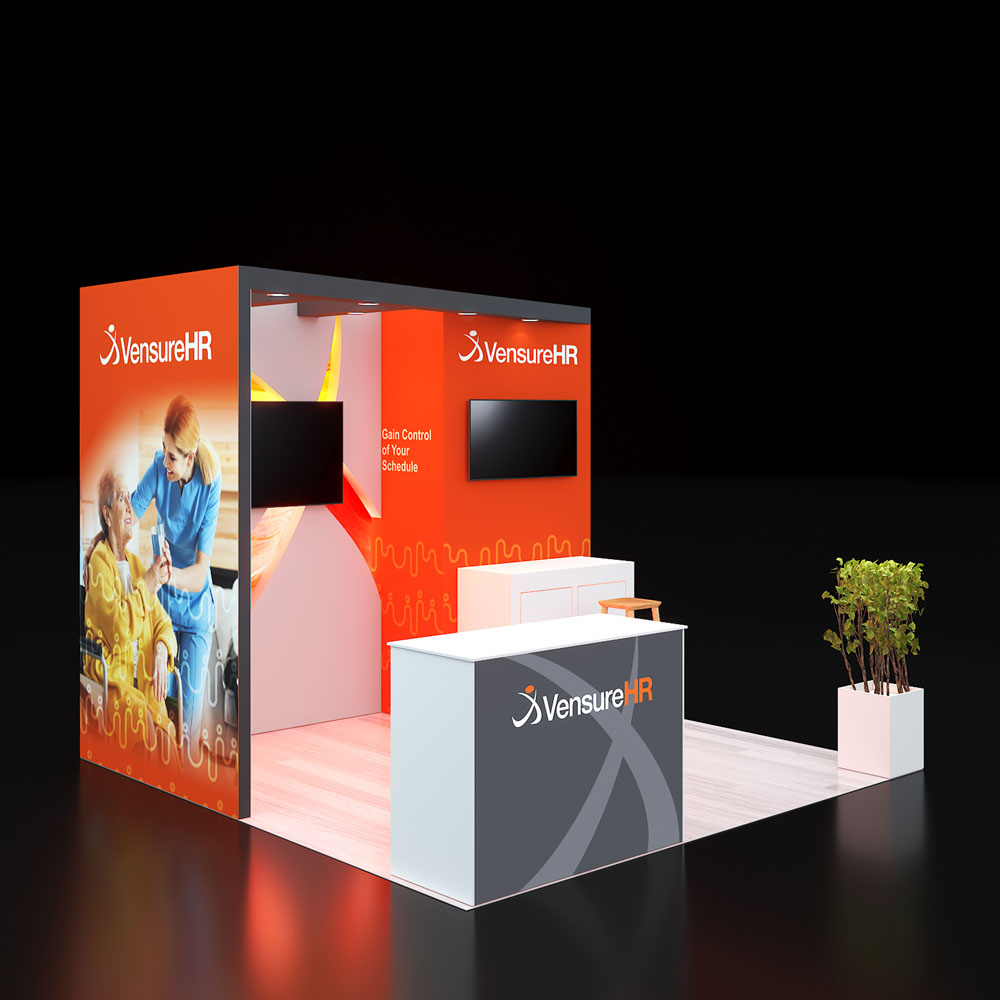
10x20: The Performance Upgrade
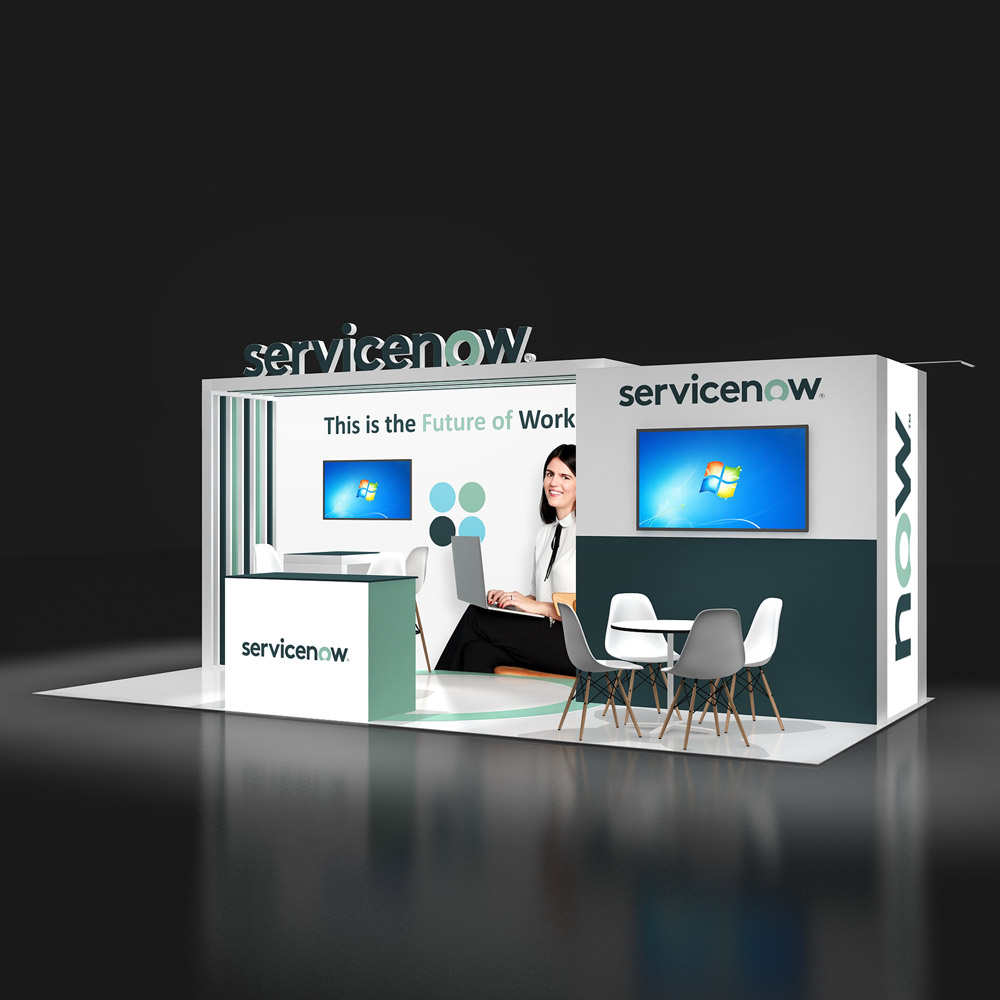
Doubling from a 10x10 to a 10x20 is one of the highest-ROI moves in trade show exhibiting. Industry benchmarks consistently show a 30–40% increase in booth foot traffic when exhibitors upgrade from 10x10 to 10x20 at the same show. The additional space allows for a defined demo zone, a conversation area, and a storage section — while the doubled backwall graphic real estate significantly increases visibility from across the aisle.
Exhibitors who attend the same show two or more years in a row at a 10x10 should strongly consider upgrading to 10x20 before investing in a more expensive custom build. The footprint upgrade often delivers more incremental impact than a dramatic design overhaul at the same size.
20x20 and Larger: Island Territory
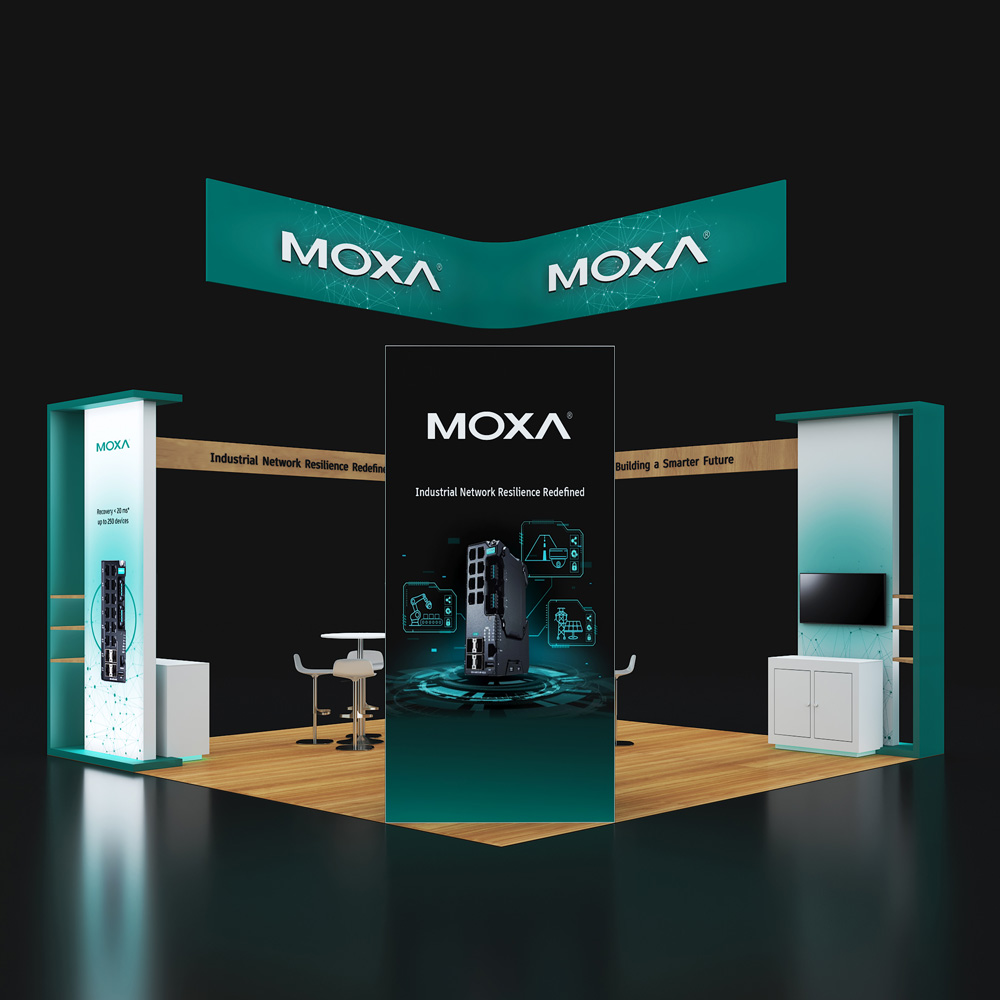
At 20x20 and above, exhibitors enter island configuration — freestanding, open on all four sides, with 360-degree foot traffic access. Island exhibits allow hanging signage above the booth (subject to show rules), double-deck structures at some venues, private meeting rooms, and large-scale product demonstration environments.
Island displays require more investment in every dimension: larger display systems, higher show floor fees, more installation labor, and greater freight costs. They're the right choice when brand presence and competitive differentiation are primary objectives — not when a well-executed inline would achieve the same lead generation goal at a fraction of the cost.
Buying vs. Renting Trade Show Displays in 2026
This is the question most exhibitors ask first — and the right answer depends entirely on how often you exhibit, how consistent your booth size and brand identity are, and what your total per-show budget looks like.
The Case for Buying
- You exhibit at 4 or more shows per year
- Your booth size is consistent across most of your show calendar
- Your brand identity is stable — graphic reprints won't be frequent
- You have dedicated logistics support for storage and shipping
- You want full control over scheduling, graphic updates, and setup
- Ownership delivers the lowest cost-per-show once the system is used across 4–6 events. The breakeven point for most mid-range display systems versus equivalent rental programs is typically 3–4 shows. After that, ownership becomes significantly more cost-efficient — assuming storage and maintenance costs are factored in. A common underestimate: annual maintenance, storage, and graphic refreshes typically add 15–25% to the original purchase price on an annualized basis.
The Case for Renting
- You attend 1–3 shows per year
- Your booth size varies between events
- You're testing a new show or market before committing capital
- You have overlapping show dates requiring simultaneous displays
- You want to refresh your visual look between shows without reprinting owned graphics
- Modern rental display programs are far from generic. Dye-sublimation stretch fabric graphics produce show-specific visuals at rental quality levels that are indistinguishable from purchased displays on the floor. Renting converts capital expense into a predictable operational cost with no storage, maintenance, or obsolescence risk.
The Hybrid Approach
Many experienced multi-show exhibitors use a hybrid strategy: own a modular portable base system for standard inline shows, and rent supplemental elements — counters, backlit towers, monitor mounts, flooring — for events that require a larger or more premium presence. This approach maximizes flexibility while keeping per-show costs predictable, without full dependence on rental availability or full capital commitment to a single configuration.
What to Look for When Evaluating Trade Show Displays
Not all displays are built to the same quality standard. Here are the variables that separate professional-grade systems from budget options that disappoint on the floor:
Graphic Print Quality
Dye-sublimation printing on stretch polyester fabric is the current standard for professional trade show displays. It produces seamless, vibrant, high-resolution graphics with no visible panel joints or print artifacts. Inkjet printing on vinyl or PVC substrates is a lower-cost alternative that typically shows visible differences in color vibrancy, finish quality, and durability over multiple shows. If your display will be used more than twice, dye-sublimation fabric graphics deliver significantly better value per impression.
Frame Material and Mechanism
Lightweight aluminum alloy is the preferred frame material for portable and modular displays. It offers the best balance of structural rigidity, weight savings, and long-term durability. Tool-free connection systems — snap-button, twist-lock, or push-pin — are faster and more reliable in show environments than screw-based assembly. Heavy steel frames add unnecessary shipping weight. Plastic frames sacrifice durability for cost and typically degrade after a modest number of setups.
Backlit vs. Standard
Backlit trade show displays — where LED panels illuminate the fabric graphic from behind — produce dramatically higher visual attention on the show floor than standard front-lit alternatives. A backlit backwall pulls attendees from 30+ feet across a dense aisle. The additional cost of a backlit system (typically $500–$1,500 more than a standard equivalent) is often recovered in the first show through increased traffic and lead volume. Backlit displays are now available at portable price points — not just custom builds.
Pack Size and Shipping Weight
The core economic advantage of portable trade show displays is ground shipping via standard carriers — UPS, FedEx, or similar. Confirm that your display system packs to dimensions and weight that fall within standard parcel limits before purchasing. Systems that require even a small LTL freight shipment lose most of their portability advantage. For multi-show programs, shipping cost is often the second-largest per-show expense after show floor fees — optimizing pack size matters.
Accessory Compatibility
The best display systems are designed as platforms, not single products. Look for frames that support compatible counters, literature racks, monitor mounts, overhead lighting, tablet stands, and flooring. A modular accessory ecosystem allows your display to grow with your program without requiring structural replacement — protecting your initial investment across multiple show seasons.
Trade Show Display Trends in 2026
The US trade show display market has shifted significantly over the past two years. Here is what's driving the most successful exhibits on the floor today:
Backlit Displays Are Now the Baseline
Backlit tension fabric systems have moved from a premium upgrade to a standard expectation at competitive shows. Exhibitors showing up with standard front-lit displays at major national trade shows are increasingly at a visibility disadvantage. If your current display doesn't include backlighting, upgrading that element alone — before replacing your entire structure — can significantly improve booth performance at the next show.
Modular and Reusable Systems Are the Strategic Default
The exhibitor community has largely moved away from single-use or single-configuration displays toward modular systems that reconfigure across show sizes and seasons. This shift is driven by both cost efficiency and growing venue sustainability mandates — many major convention centers now require documentation of sustainable material sourcing, and aluminum alloy modular systems satisfy most of those requirements by default.
Immersive and Interactive Elements Are Now Accessible at Any Budget
Touchscreen kiosks, product demonstration stations, QR-code-driven digital experiences, and even augmented reality product visualization are now accessible at mid-market exhibit budgets. Exhibitors who activate at least one interactive element report meaningfully higher dwell times and lead volumes than exhibitors with passive display-only setups. The key is relevance — the interaction must be directly tied to your product or service to produce qualified conversations, not just booth traffic.
Sustainability Is a Design Brief, Not an Afterthought
An increasing number of US trade shows require exhibitors to document material sourcing and limit single-use materials. Dye-sublimation fabric graphics on recycled polyester, aluminum alloy frames, modular reusable structures, and LED lighting all satisfy most current venue sustainability requirements — and increasingly signal brand credibility to environmentally conscious buyers on the floor.
For more on booth ideas that drive engagement across all display types, 20 Trade Show Booth Ideas That Attract Visitors in 2026 covers proven tactics from major US shows.
Budgeting for Trade Show Displays in 2026
Display cost is only one component of the total per-show investment. Here is a realistic budget framework for exhibitors planning a 10x10 to 10x20 inline booth:
- Display purchase or rental: $1,500–$15,000 depending on format and size
- Graphic design: $800–$2,500 for professional design if not handled in-house
- Graphic printing (reprints for each show): $300–$1,500
- Ground shipping per show: $75–$400 via UPS or FedEx
- Drayage at venue: $150–$800 — venue charge to move shipment from loading dock to booth
- Show floor accessories (lighting, counter, monitor mount, flooring): $500–$3,000
- Installation labor (if required): $400–$2,500 depending on show union rules and exhibit complexity
- Branded collateral and giveaways: $500–$3,000
A fully equipped professional 10x10 inline setup — including display, accessories, shipping, drayage, and collateral — realistically runs $8,000–$20,000 all-in for a single show. A 10x20 configuration typically runs $15,000–$35,000 all-in. The display purchase is typically 20–40% of the total per-show investment — a figure most new exhibitors significantly underestimate when planning their first show.
How to Find a Verified Booth Builder for Your Trade Show Display
For exhibitors sourcing a custom-fabricated display, upgrading an existing modular system, or finding a reliable rental partner for a specific show, working with the right builder is as important as choosing the right display format.
Most exhibitors run into the same obstacles when searching independently: no reliable way to verify builder quality, inconsistent quotes with no basis for comparison, and no visibility into how a builder's work has actually performed on the show floor at the events you're targeting.
That's the problem Exhibitorly.com solves. Exhibitorly is a marketplace platform that connects exhibitors with verified booth builders across the United States. You can browse builder profiles, review their past exhibit work, compare capabilities across vendors, and find the right match for your display type, show, and budget — all in one place, without starting from scratch with cold outreach.
Before engaging any builder, read the Ultimate Guide to Hiring a Trade Show Booth Builder for a complete vetting framework.
Top 2026 Trade Shows to Plan Your Display Strategy Around
Exhibitorly connects you with verified display builders experienced at the full range of major US trade shows. Here are some of the top 2026 events where display quality directly affects competitive performance:
- Booth Builders for IMTS 2026
- Booth Builders for FABTECH 2026
- Booth Builders for InfoComm 2026
- Booth Builders for SEMA Show 2026
- Booth Builders for PACK EXPO 2026
- Booth Builders for NAB Show 2026
- Booth Builders for BIO International Convention 2026
- Booth Builders for HIMSS 2026
- Booth Builders for SuperZoo 2026
- Booth Builders for Cosmoprof 2026
- Booth Builders for RE+ 2026
- Top US Trade Shows June & July 2026
- Top US Trade Shows August 2026
Find the Right Trade Show Display with Exhibitorly
The right trade show display doesn't just look good — it works. It stops traffic, communicates value in seconds, and creates the physical environment where your best conversations happen. Getting there means matching the right format to your goals, investing in graphic quality and lighting, and working with a builder who understands how displays actually perform at the specific shows you're targeting.
Exhibitorly.com connects you with verified booth builders across the US who specialize in every display format — from portable pop-ups and tension fabric backwalls to custom island builds and rental programs for specific shows. Start your search, compare builders, and show up with a display that earns its investment.