

Trade Show Shipping: Costs, Methods, and How to Save
Trade show shipping breaks into distinct cost layers: origin freight to the venue city, optional advance warehouse storage, drayage to move freight from the dock to your booth, and return freight home. For a mid-size booth, total shipping and handling typically runs $3,000 to $10,000 per show once every layer is included, far more than the freight quote alone suggests. This guide walks through what each layer actually costs, how trade show shipping companies price freight versus drayage, the small-print rules (weight minimums, overtime surcharges, target dates) that quietly inflate invoices, and the concrete steps that cut costs without cutting corners. Get the cost structure right before you book, and the invoice stops being a surprise.
Most exhibitors budget for one line item, freight, and get surprised by four more. Shipping accounts for roughly 9 percent of the average exhibit budget, and industry surveys consistently find exhibitors underestimating their total trade show costs by 20 percent or more, mostly because of shipping and handling fees nobody warned them about.
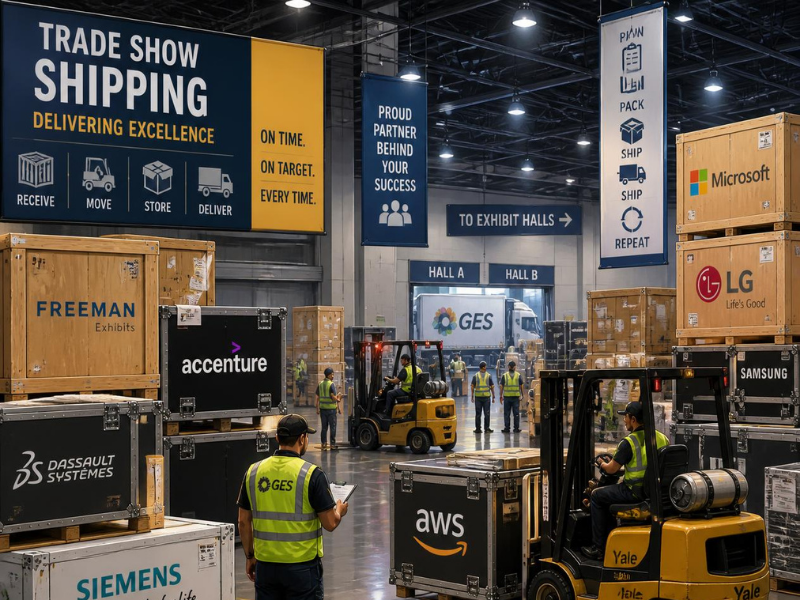
Trade show shipping isn't just a carrier picking up a crate and dropping it off. It's freight to the venue city, possible advance warehouse storage, mandatory drayage to move that freight from the loading dock to your booth, and freight again to get everything home. Understanding each layer before you book anything is the difference between a shipping bill you planned for and one that blows up your budget on the invoice.
What Counts as Trade Show Shipping?
Trade show shipping is often used as a catch-all term, but it actually covers several distinct services that get billed separately. Origin freight is the standard shipping cost of moving your booth materials from your facility to the show city, priced like any other freight shipment by weight, distance, and mode. Drayage is a different service entirely: it's the mandatory material handling charge at most major US convention centers for moving your freight from the loading dock (or an advance warehouse) to your actual booth space, and moving it back afterward. Return freight is the shipping cost of getting everything home once the show closes.
Confusing these three, or budgeting for only the first one, is the single most common trade show shipping mistake. A freight quote from your carrier tells you almost nothing about what drayage will cost, and the two show up as completely separate line items on your show services invoice.
The Real Cost of Trade Show Shipping
Origin freight costs scale with booth size and shipping method. A small booth, banner stands or a pop-up packed into hard cases, typically ships for $200 to $600 round trip via parcel carrier or small LTL freight. A mid-size modular booth with several crates usually runs $600 to $2,000 round trip. A large island exhibit on pallets in custom crates can run $2,500 to $8,000 or more round trip, often requiring a dedicated truck.
That's freight alone. Once advance warehouse fees, drayage, and return shipping are added, total shipping and handling for a mid-size booth typically lands between $3,000 and $10,000 per show. For a large island exhibit at a major venue, the number climbs considerably higher. None of this includes booth space rental, show services like electrical and internet, or travel, which is exactly why shipping catches so many exhibitors off guard when they've only budgeted for the freight quote.
Trade Show Shipping Methods: Freight, Small Package, or Dedicated Truck
Exhibitors generally choose between a few shipping methods, and the right one depends on booth size and how much risk you're willing to accept.
A dedicated truck, a sprinter van or straight truck carrying only your freight, offers the highest reliability. Your shipment doesn't share trailer space, you get real-time tracking, and a driver can adjust in real time if something goes wrong. It costs roughly 30 to 50 percent more than shared freight but eliminates most handling risk, which matters more for large or fragile exhibits.
Trade show LTL (less-than-truckload) freight uses the show's official carrier network and costs meaningfully less, but your freight shares trailer space with other exhibitors' shipments and follows the carrier's consolidation schedule, adding extra handling touches along the way. This is the standard choice for small and mid-size booths, and it's usually listed as the "official carrier" in your exhibitor services kit.
Small package carriers, FedEx, UPS, DHL, work fine for very small shipments like literature or a single hard case, but each package can trigger its own per-piece drayage minimum at the venue, which makes shipping several small boxes individually far more expensive than consolidating them into a single palletized shipment.
Understanding Drayage: The Cost Most Exhibitors Don't See Coming
Drayage is where trade show shipping budgets go wrong most often. At most major US convention centers, you cannot move your own freight from the dock to your booth. That job belongs exclusively to the show's appointed general service contractor, working under a union labor agreement with the venue, and you pay for it separately from freight.
Drayage is priced by weight, specifically by the hundredweight, or CWT, where one CWT equals 100 pounds. Typical rates at major US venues run $60 to $180 per CWT for round-trip handling, with Las Vegas and Chicago venues commanding a 20 to 30 percent premium over the average. A 700-pound exhibit generates roughly 7 CWT; at $140 per CWT for advance warehouse drayage, that's about $980. The same shipment delivered direct to show site at a higher rate might cost $1,260, a meaningful gap for functionally the same freight.
A handful of rules catch first-time exhibitors specifically. Every shipment is rounded up to the next 100 pounds, so 201 pounds bills as 300. Most shows impose a minimum charge, often 200 pounds, per piece, regardless of actual weight, meaning a 25-pound box still incurs the full minimum. And each piece is billed separately: five boxes shipped individually generate five minimum charges, while the same items consolidated onto a single pallet generate one charge based on actual weight. Overtime is its own trap. Most contractors define straight time as weekday business hours; unloading that begins even minutes after the cutoff, or on a weekend, triggers a surcharge of 30 to 50 percent on the entire drayage bill, not just the late portion.
Advance Warehouse vs. Direct-to-Show Shipping
Most large shows offer an advance warehouse option: a staging facility near the venue where you can ship freight days or weeks ahead of the show, with the contractor receiving, storing, and later delivering it to your booth during move-in.
Advance warehouse storage typically costs $5 to $15 per CWT per month, plus handling fees. That sounds like an added cost, and technically it is, but the advance warehouse drayage rate is almost always lower than the show-site rate, often by 20 to 30 percent. For most exhibitors, shipping to the advance warehouse and paying the storage fee costs less overall than shipping direct to show and paying the higher on-site drayage rate. Both rates are published side by side in the exhibitor services manual, and running the actual math on both options before deciding is worth the ten minutes it takes.
Trade Show Shipping Companies: What to Look For
Not every carrier understands trade show freight, and the ones that don't can cost you money through missed deadlines or unfamiliarity with drayage rules. Good trade show shipping companies know the difference between a standard commercial delivery and a show freight shipment with a hard target date, understand how to coordinate with the show's general service contractor, and can advise on advance warehouse versus direct-to-show tradeoffs before you book.
Ask any carrier you're evaluating whether they specialize in trade show freight shipping specifically, what their on-time record looks like for target-date deliveries, and whether they book both inbound and return freight together so your return trip isn't left to last-minute spot-market pricing. That last point matters more than it sounds: booking return freight before the show, rather than scrambling on move-out day when every exhibitor at the venue wants a truck at the same time, avoids paying a premium for availability you could have locked in weeks earlier.
Trade Show Shipping Cases and Containers: Packing for Freight
How you pack directly affects what you pay, since drayage is priced by weight and per piece. Hard-sided trade show shipping cases, ATA-rated road cases built for repeated freight handling, protect equipment and graphics better than cardboard while consolidating multiple items into fewer billable pieces. For larger exhibits, custom trade show shipping containers or crates sized to a specific booth's components reduce the loose, individually-handled pieces that trigger per-piece minimums.
The packing principle that saves the most money is simple: consolidate. Everything that can go into one properly documented case or onto one pallet should. Loose boxes, individually shipped literature cartons, and stray small packages each carry their own drayage minimum, and that adds up fast on a show with even a modest number of pieces. Reusable trade show shipping containers built specifically for your booth's dimensions also pay for themselves over a few shows, since a purpose-built container ships and drayages more predictably than mismatched packaging assembled show to show.
How to Reduce Trade Show Shipping Costs
A handful of concrete steps consistently lower the total shipping and handling bill. Consolidate everything into as few pieces as possible before it ships, since fewer pieces means fewer minimum drayage charges. Ship to the advance warehouse rather than direct to show whenever the math favors it, which is most of the time. Reduce total weight wherever you can: replace printed literature with digital displays, use lightweight modular booth structures instead of heavy custom builds, and ship floor samples instead of full inventory. Hit your assigned target date and delivery window, since arriving even slightly outside straight-time hours can trigger a full overtime surcharge on the entire drayage bill, not a prorated portion. And submit material handling forms before the exhibitor kit deadline, since late submissions can add fees or push your freight down the priority queue during a busy move-in.
Booth construction choices matter as much as shipping decisions here. A modular trade show booth that flat-packs into a handful of lightweight cases costs a fraction to ship and drayage compared to a heavy custom timber build, and it's reusable at your next show instead of built once and discarded.
A Sample Trade Show Shipping Budget
A concrete example makes the layered costs easier to plan around. Take a 10x20 modular booth weighing roughly 1,200 pounds, shipped to a major venue using advance warehouse delivery. Origin freight typically runs $1,800 to $2,500, and advance warehouse storage for two weeks adds another $200 to $400. Inbound drayage at an advance rate around $140 per CWT on 12 CWT comes to roughly $1,680, and outbound drayage at the same rate adds another $1,680. Return freight home runs another $1,800 to $2,500, and cargo insurance at roughly 1.5 percent of declared value rounds out the total. Add it all up, and shipping and handling for that booth lands somewhere between $7,000 and $9,000. That's shipping and handling only, before booth space rental, show services, or travel.
Shipping typically shows up as one line in a broader trade show budget, and it's worth planning for early rather than discovering it on the final invoice. The deadlines for material handling forms, advance warehouse shipments, and carrier booking all fall well before the show itself, which is exactly the kind of detail a trade show checklist should track alongside every other pre-show task.
Where Shipping Meets Move-In Day
Shipping decisions and move-in execution are two halves of the same process. Freight that arrives on time and well-consolidated still needs a booth crew ready to receive it, unpack it, and get the exhibit built before the floor opens. Our booth setup and install day guide covers what happens once your freight clears drayage and lands at your booth space, and our broader trade show logistics guide covers the rest of the operational picture around shipping, from labor scheduling to on-site coordination.
What Is Exhibitorly?
Exhibitorly is a free marketplace that helps exhibitors find and compare vetted trade show booth builders. Instead of researching contractors one by one, exhibitors submit a single project brief covering their show, booth size, and goals, then receive quotes from multiple qualified builders to compare side by side. The platform covers booth design and construction for shows across every industry, and every builder in the Exhibitorly network is vetted for experience with the venues and show formats exhibitors actually work with, including venue-specific freight and drayage procedures. For a deeper look at how the platform works end to end, see our guide to what Exhibitorly is and how it works.
Planning your presence at International Fastener Expo 2026 or Groceryshop 2026? Compare vetted booth builders on Exhibitorly and design an exhibit that ships light, handles cleanly, and keeps your shipping budget where you planned it.