

What Is an Exhibition Booth? Types, Sizes & Costs Explained
A booth in exhibition terms is the floor space a company rents at a trade show or expo, plus the display it builds to fill that space. In the US it is called a booth; in the UK and Europe it is usually an exhibition stand. Booths come in standard types (in-line, corner, perimeter, peninsula, island and tabletop) and sizes starting at 10x10. In 2026, the display alone runs from a few hundred dollars for a tabletop setup to $120,000 or more for a custom 20x20 island.
Exhibition booth definition
An exhibition booth is a defined area of floor space that a company rents at a trade show, expo or conference, plus the display it builds or rents to fill that space. The organizer sells the space. The exhibitor supplies everything that turns it into a branded environment: walls or backdrop, graphics, counters, lighting, screens, flooring and furniture.
That split matters. "Booking a booth" usually means buying the empty space. "Building a booth" means the display that goes on it. Your budget, timeline and vendors are different for each.
A booth's job is simple: stop people walking the aisle, explain what you do in seconds, and give your team room to qualify leads, run demos or hold meetings.
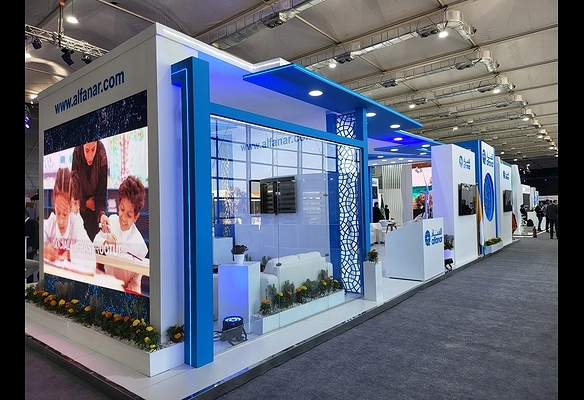
Booth vs. stand: US and UK terminology
The words change by region, but the thing is the same.
- US: "booth," "trade show booth," "exhibit" or "display." The rented area is "booth space" or "floor space."
- UK, Europe and much of Asia: "stand" or "exhibition stand." The rented area is often sold as "space only" or "shell scheme."
Space only is a clearly marked, empty area. You supply everything, including walls, flooring, lighting and power. It is the equivalent of raw space for a US island booth.
Shell scheme is a pre-built stand set up by the organizer's contractor. It has a metal frame and lightweight wall panels, a nameboard (fascia) with your company name and stand number, and usually carpet. The closest US equivalent is the standard pipe-and-drape booth package, though a shell scheme gives you hard walls instead of fabric drape.
Exhibition booth types
Booth type describes how many sides face an aisle. It controls how tall you can build and what you can hang overhead. US floor plans are laid out in 10-foot increments, so most booth sizes are multiples of 10.
In-line (linear) booth
The most common exhibition booth. It sits in a row with neighbors on both sides and opens to one aisle. Standard size is 10x10. The typical height limit is 8 ft, allowed only in the rear half; the front half stays at 4 ft so neighbors are not blocked.
Corner booth
An in-line booth at the end of a row, open to two aisles. The same height rules apply. You pay a corner premium at many shows for the second stream of traffic.
Perimeter booth
An in-line booth backed against an outside hall wall. Because nothing sits behind it, the back wall can typically go to 12 ft.
Peninsula booth
Open on three sides and usually 20x20 or larger. It backs onto in-line booths, so the back wall must stay at 4 ft within 5 ft of each aisle. The center can typically rise to 16–20 ft, and hanging signs are usually allowed.
Island booth
Open on all four sides, typically 20x20 or larger. You can use the full cube of space up to the show's height limit, usually 16–20 ft including signage. Islands get the most visibility and the most rules: drawings, hanging-sign approval and sometimes engineering stamps.
Tabletop exhibit
Common at smaller conferences, association meetings and job fairs. You get a 6 ft or 8 ft table, sometimes with a short backdrop zone behind it. A tabletop display, printed table throw and banner stand cover most of the setup.
Show rules vary. Treat these heights as the common US baseline and confirm limits in your show's exhibitor manual.
Standard exhibition booth sizes
The 10x10 is the standard starting size. Larger booths scale in 10-foot steps.
| Booth size | Square feet | Usual booth types | Typical use | Staff per shift |
|---|---|---|---|---|
| Tabletop (6–8 ft table) | Varies | Tabletop | Small conferences, regional events | 1 |
| 10x10 | 100 | In-line, corner, perimeter | First shows, lead generation | 1–2 |
| 10x20 | 200 | In-line, corner, perimeter, end-cap | Product demos, small seating area | 2–3 |
| 10x30 | 300 | In-line | Multiple demo stations along one aisle | 3–4 |
| 20x20 | 400 | Peninsula, island | Hanging signs, meeting space, several zones | 4–6 |
| 20x30 and larger | 600+ | Island | Flagship presence, multi-story options | 6+ |
For a deeper comparison, see our guide to trade show booth sizes: 10x10 vs 10x20 vs 20x20.
What's included with booth space (and what isn't)
A standard in-line booth package at most US shows is minimal. It typically includes:
- 8 ft high back drape on pipe
- 3 ft high side drape (side rails) on in-line booths
- An identification sign, often 7 x 44 inches, with company name and booth number
- A listing in the show directory, floor plan and app
- Exhibitor badges, usually a set number per 10x10
- General hall security outside show hours
Island and peninsula space is usually sold as raw space: a taped outline on bare concrete and a directory listing.
Everything else is ordered separately, usually through the show's official contractor:
- Carpet or flooring (many shows require it and will carpet your booth at your cost if you don't)
- Furniture, counters and tables
- Electrical, internet and phone
- Material handling (drayage) to move your freight to the booth
- Installation and dismantle labor
- Booth cleaning and dedicated security
- Audio-visual equipment
Pipe and drape is a backdrop, not a booth. To look professional, you need a display built for your space.
Exhibition booth build options and 2026 costs
There are four main ways to fill your space. The right one depends on how often you exhibit, your booth size and how much your brand needs to stand out.
- Portable (pop-up and fabric) displays: Lightweight frames with printed fabric or panels. Set up in minutes without tools and ship in a bag or case. Best for 10x10 and tabletop booths and tight budgets. See our guide to portable pop-up trade show displays.
- Modular booths: Aluminum extrusion kits with fabric graphics that reconfigure for different sizes. A strong fit for teams exhibiting several times a year at mixed booth sizes. Compare options on our modular booths page.
- Rental booths: A builder designs and supplies the structure, graphics and often setup for one show. You get a custom look without owning, storing or shipping a booth.
- Custom builds: A booth designed and fabricated for your brand, usually for 20x20 islands and larger. Highest impact, highest cost and the longest lead time. Explore custom booth builders.
| Build option | 10x10 (typical 2026 range) | 10x20 (typical 2026 range) | 20x20 (typical 2026 range) | Best for |
|---|---|---|---|---|
| Tabletop display | About $240–$1,650 for a complete table setup | Not applicable | Not applicable | Small conferences |
| Portable pop-up or fabric (buy) | About $500–$2,600 | Up to about $7,300 for a 20 ft backlit display | Rarely used alone | First shows, frequent travel |
| Modular kit (buy) | About $3,300–$12,400 | About $13,900–$23,000 | About $20,400–$27,900 | Repeat exhibitors, mixed sizes |
| Rental package (per show) | About $3,500–$6,500; up to ~$14,000 for custom-designed rentals | About $6,500–$14,000 | About $14,000–$45,000 | 1–3 shows a year, custom look without ownership |
| Custom build (buy) | About $8,000–$20,000 | About $15,000–$40,000 | About $40,000–$120,000+ | Large booths, strong brand presence |
These ranges cover the booth only. Floor space at major US shows typically runs $100–$150 per square foot, so a 10x10 costs about $10,000–$15,000 in space alone. A common planning rule puts total show cost at roughly three times the space cost once you add services, freight, travel and staffing.
A simple break-even check helps with rent vs. buy. A 10x20 modular kit that sells for about $20,000 and rents for about $8,750 per show passes rental cost during its third show, before storage and graphic refreshes.
What makes an exhibition booth work
Size and budget matter less than most first-time exhibitors think. The booths that pull traffic share a few traits.
- One clear message, high up. Attendees decide in seconds whether to stop. Put your company name and a single line about what you do above eye level on the back wall, where it stays visible over crowds.
- An open front. Tables across the front edge act as a wall. Move counters to one side or angle them so people can step in.
- A reason to stop. A live demo, a product people can touch or a short screen loop gives visitors something to do while your team starts a conversation.
- Light where it counts. Hall lighting is flat. Backlit graphics or arm lights on the main wall make a small booth read from far down the aisle.
- Hidden storage. Boxes, coats and bags on view make a booth look unfinished. Plan a closet, a counter with doors or space behind the back wall.
- A layout that fits the staff. Plan roughly 50–75 sq ft of open floor per staffer. Overcrowded booths turn visitors away.
A common mistake is designing for the rendering instead of the aisle. Check how the booth looks from 30 feet away, at walking speed, with three people standing in it.
How to get an exhibition booth: 5 steps
- Book your space. Choose the show, then the booth size and type. Popular shows sell out, and returning exhibitors often pick first, so apply early. Lock space 6–12 months out for major shows.
- Read the exhibitor manual. Note height limits, design-approval deadlines, carpet rules and the cutoff for discounted service orders.
- Write a booth brief. List your goals, booth size, budget, key messages, demos, storage, meeting needs and the show dates.
- Compare builders. Send the same brief to several builders so proposals line up side by side. Get 3 free quotes from vetted builders on Exhibitorly and compare designs, pricing and what each quote includes.
- Approve design and order services. Sign off on renderings, submit any required drawings to the show, and order flooring, electrical and labor before the advance-rate deadline.
For booth-specific planning, start with the 10x10 trade show booth guide or the 20x20 trade show booth guide. If you want one partner to handle design, rental, shipping and setup, compare trade show booth rental options on Exhibitorly.
Related guides