
Trade Show Lead Retrieval: The Complete Guide for Exhibitors
Trade show lead retrieval is how exhibitors capture attendee contact details at a booth, usually by scanning a badge's QR code or barcode, and turn that scan into a usable, CRM-ready lead. The technology has moved past rented handheld scanners toward any-phone apps that add qualification notes, sync in real time, and work offline when convention Wi-Fi inevitably struggles. This guide covers how modern lead retrieval systems for trade shows actually work, what separates a genuinely useful lead retrieval app from one that just makes a list of names, and how to structure your booth and your team so captured leads turn into pipeline instead of dead weight in an export file. Get the workflow right and the other 80 percent stops disappearing.
Here's a number that should bother anyone who signs off on a trade show budget: 80 percent of trade show leads never receive a single follow-up, according to research from CEIR (Center for Exhibition Industry Research). Not a bad follow-up. No follow-up at all. The badge gets scanned, the conversation ends, and the lead disappears into a spreadsheet nobody opens until it's too cold to matter.
That gap is almost never a scanning problem. Every exhibitor can capture a name. The real failure sits between the scan and the follow-up, in a workflow that batches leads, strips out context, and hands sales a list of names three days after the conversation happened. Fixing trade show lead retrieval means fixing that workflow, not just buying a fancier scanner. If your team is still finalizing the broader event plan, our trade show checklist for exhibitors covers where lead capture fits into the pre-show and at-show phases.
What Is Trade Show Lead Retrieval?
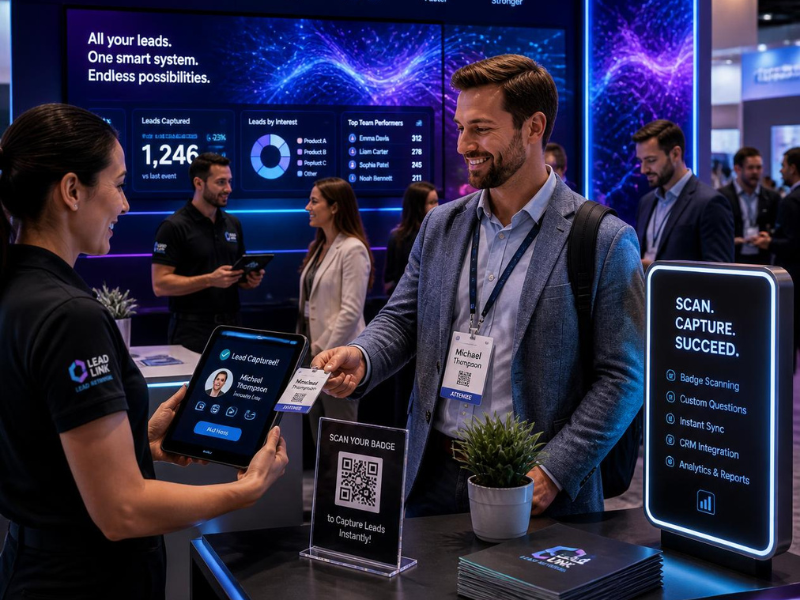
Trade show lead retrieval is the process exhibitors use to capture a prospect's contact information at a booth, most commonly by scanning the QR code or barcode printed on their event badge with a phone, tablet, or dedicated scanner. The scan pulls the attendee's registration data, usually name, company, title, and email, and drops it into a structured lead list tied to your booth instead of a stack of business cards you'll sort through weeks later.
Done well, trade show lead retrieval takes a booth conversation and turns it into a clean, qualified record your sales team can act on immediately. Done badly, it produces exactly what it was supposed to replace: a pile of names with no context, no priority, and no clear next step. Because lead capture feeds directly into pipeline, it's really a marketing-funnel decision as much as an operations one, and it's worth reading alongside our broader guide to trade show marketing if you're building out your full pre-show plan.
How Trade Show Lead Retrieval Actually Works
Every attendee at a well-run trade show carries a unique identifier on their badge, almost always a QR code or barcode, occasionally an NFC chip. That code points back to their registration record. When a booth staffer scans it, a lead retrieval app pulls the associated contact details and adds the person to a lead list for that show, usually in a couple of seconds. This is the mechanical core of trade show lead capture, and it's the same basic motion whether you're running a rented handheld unit or an app on your own phone.
The scan itself is the easy part. What separates a strong trade show lead retrieval setup from a weak one is what happens in the ten seconds immediately after: does the rep get a chance to add a note, tag the conversation, or flag urgency before moving on to the next visitor? That context, not the raw contact detail, is what tells your follow-up team who to call first on Monday morning.
Lead Retrieval Systems for Trade Shows: Comparing Your Options
Exhibitors generally choose between four approaches to capturing leads, each with real tradeoffs.
Business cards collected in a bowl are free and require no setup, but the data quality is poor, there's no conversation context, and follow-up realistically takes days to weeks, if it happens at all.
A rented proprietary scanner, the traditional show-organizer option, captures good structured data but charges per device, per day, plus additional fees, and you hand the hardware back at the end of the show. Your team is also stuck rationing however many units you rented across however many staff are working the booth.
An any-phone lead retrieval app turns the phones your team already carries into scanners. There's no rental fee, every rep can capture leads simultaneously instead of sharing two units, and the better platforms let staff add qualification notes and sync to a CRM in real time rather than exporting a file after the show closes.
NFC smart badge taps are the newest option and work well for very large expos with the budget and infrastructure to support them, offering a fast tap-to-capture experience. For the large majority of trade shows, though, an any-phone lead retrieval app for trade shows captures comparable data with better context and no hardware to return.
Whichever approach you land on, the underlying goal for lead retrieval for trade shows doesn't change: get a clean, contextual record of the conversation into your team's hands as close to real time as possible. The method matters less than whether it actually supports that goal under real show-floor conditions.
What a Trade Show Lead Retrieval App Should Actually Do
A basic badge scanner app only solves the easiest part of the problem: getting a name into a list. A strong trade show lead retrieval app needs to do more, across seven jobs. Teams evaluating lead retrieval for trade shows for the first time often assume scanning speed is the deciding factor, when it's usually the least important item on this list.
It should capture the lead quickly, through badge scans, QR codes, barcodes, business cards, name tags, or manual entry, since not every show badge encodes the same information. It should preserve the actual booth conversation by letting staff add notes, tags, product interest, and next steps without slowing the exchange down. It needs to work without reliable Wi-Fi, because convention center connectivity is notoriously inconsistent exactly when every booth is hammering it at once. It should help clean up the record by reducing duplicates and filling in missing fields. It needs to sync cleanly to the CRM your sales team actually uses, respecting field mapping, ownership, and campaign association rather than dumping a messy CSV. It should help trigger relevant follow-up based on what was actually discussed, not a generic "thanks for stopping by" template. And it should report on quality, not just volume: the useful number isn't how many badges you scanned, it's how many qualified conversations turned into meetings and pipeline.
The Buying Criteria That Separate Useful Tools From Shiny Demos
When you're evaluating lead retrieval systems for trade shows, a live demo tells you far more than a feature page. A few questions expose the tools that will actually hold up on a busy show floor.
Ask what happens with a low-light or damaged badge, not just a clean one. Ask how the app behaves with Wi-Fi turned off, and how it handles two reps capturing the same person offline before syncing. Ask exactly how CRM sync handles duplicate records, lead ownership, and failed syncs, since "we integrate with Salesforce" means very little without those details. And ask how much friction the qualification step adds. If it takes booth staff more than about thirty seconds to log a note and move on, they'll skip it under real show-floor pressure, and you'll be back to a list with no context.
The honest question worth asking any vendor is simple: what happens when the badge data is bad, the Wi-Fi is worse, and the prospect matters?
Booth Design and Staffing: Where Lead Retrieval Actually Happens
Lead retrieval doesn't happen in a vacuum. It happens at a physical booth, and booth layout has a direct effect on capture quality. A trade show booth design that funnels visitors past a single choke point creates a bottleneck where reps rush scans just to keep the line moving, which is exactly when qualification notes get skipped. A layout with multiple engagement points, whether that's demo stations, product displays, or simple conversation counters, spreads capture across your team and gives each rep the thirty seconds needed to log real context.
Booth footprint matters here too. Larger island configurations can support dedicated meeting areas where a qualified lead gets a longer, higher-context conversation away from foot traffic. Smaller footprints, including portable and pop-up trade show displays, change the calculus: with less space and often a smaller staff, capture and qualification need to happen faster and with tighter, more disciplined qualifier questions, since there's no side room to move a promising conversation into.
Either way, brief your booth staff on lead retrieval before the show opens, not on day one while the doors are already open. Decide what counts as a qualified lead, agree on two or three fast qualifier questions everyone will actually use, and test the app's offline behavior before you're relying on it in a hall with terrible signal.
Preparing Your Team Before the First Event
Even a well-chosen trade show lead retrieval app can underperform if the rollout is an afterthought. A few steps make the difference between clean data and a mess you're untangling for weeks after the show.
Define what makes a lead sales-worthy before the event starts, so not every scan counts as a win. Keep required fields short enough that reps will actually complete them mid-conversation. Set a rule for what happens the moment a high-priority account walks up to the booth. Train staff specifically on the first twenty seconds of a scan: how to capture, tag, note, and move on without breaking the flow of conversation. Test devices, permissions, and offline sync before the booth opens, not after the first line of attendees forms. And if you're running a multi-day show, review captured leads daily rather than waiting until the event ends, since same-show follow-up consistently outperforms the version that waits for a plane ride home.
Turning Captured Leads Into Pipeline
Capture is only half the job. The data on follow-up timing makes the other half impossible to ignore. Leads contacted within five minutes convert at dramatically higher rates than leads contacted even thirty minutes later. Response rates hold in the 30 to 45 percent range for leads followed up within 24 hours, but fall to 15 to 25 percent at the 24 to 48 hour mark, and collapse to single digits after five days.
The average cost per lead at a B2B trade show runs $150 to $500, factoring in booth, travel, staff time, and technology, according to Exhibit Surveys and CEIR benchmarking research. That means every unfollowed lead isn't a missed opportunity in the abstract, it's a specific dollar figure walking out the door. If your team captures 50 qualified leads and the industry-average 80 percent go unfollowed, 40 of those leads, and everything you spent to earn the conversation, are gone. Our trade show ROI guide breaks down the cost-per-lead and lead-qualification-rate benchmarks that this math feeds directly into, so you can see exactly how a fixed follow-up process moves your overall return.
The fix is structural, not heroic. Real-time or same-day follow-up, built on the qualification notes captured during the actual conversation, consistently outperforms a batch process that waits until the show ends to even open the export file. A smaller number of well-qualified, well-documented leads beats a giant stack of unvetted scans every time, because a thousand nameless contacts is a thousand generic emails and a weak response rate, while two hundred scans with real context is a sales team that knows exactly who to call first.
What Is Exhibitorly?
Exhibitorly is a free marketplace that helps exhibitors find and compare vetted trade show booth builders. Instead of researching contractors one by one, exhibitors submit a single project brief covering their show, booth size, and goals, then receive quotes from multiple qualified builders to compare side by side. The platform covers booth design and construction for shows across every industry, and every builder in the Exhibitorly network is vetted for experience with the venues and show formats exhibitors actually work with. For a deeper look at how the platform works end to end, see our guide to what Exhibitorly is and how it works.
Planning your booth for SupplySide West 2026 or HR Tech 2026? Compare vetted booth builders on Exhibitorly and design a floor plan that supports fast, high-context lead capture from the moment the show floor opens.