

Trade Show Follow Up Email: Templates, Timing, and Examples
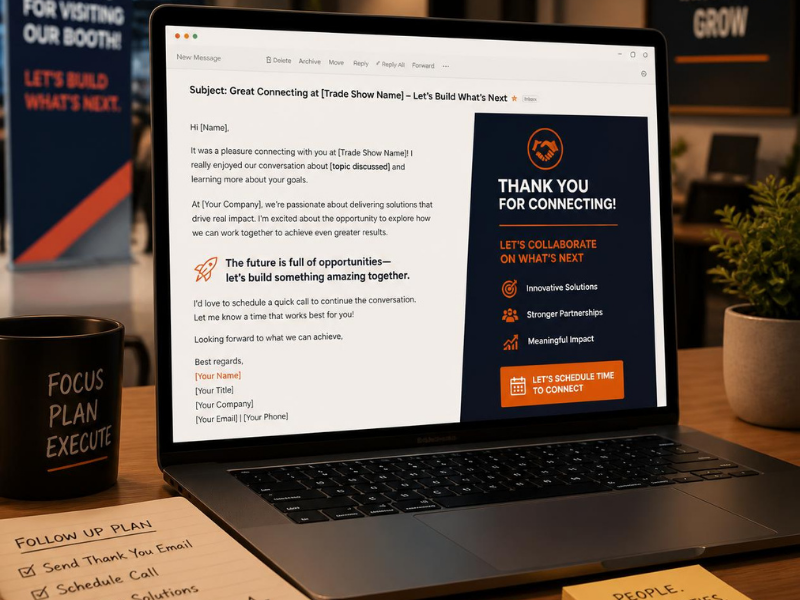
A trade show follow up email works when it does two things a generic "great meeting you" blast never does: it references something specific from the actual booth conversation, and it arrives within 24 hours while the prospect still remembers who you are. This guide walks through what to capture at the booth so you have something to reference, five follow up email templates built around different conversation types, the four-touch sequence that carries a lead from Day 1 to Day 14, and the subject-line and timing mistakes that quietly kill response rates. Get the first email right and the rest of the sequence gets much easier.
By some estimates, 38 percent of exhibitors take longer than six days to send a trade show follow up email. By then, the prospect has met a dozen other vendors, flown home, and buried your booth conversation under a hundred unread messages. Leads contacted within 24 to 48 hours of a trade show are roughly 60 percent more likely to convert than those reached after a week. The gap between those two numbers is where most of your event budget quietly disappears.
The good news is that fixing it doesn't require new software or a bigger team. It requires a follow up email that actually references the conversation you had, sent while that conversation is still fresh, followed by a short sequence instead of a single one-and-done message.
Why Trade Show Follow Up Emails Matter More Than the Booth Conversation
Every exhibitor puts real effort into the booth conversation. Fewer put the same effort into what happens after. That imbalance is expensive, because the conversation itself doesn't close anything. The follow up email does. A strong follow up email after trade show conversations is often the single highest-leverage piece of writing your team produces all quarter, and it usually takes less than five minutes.
Leads contacted within 24 to 48 hours of the show convert at meaningfully higher rates than leads reached even a week later, and the reason isn't mysterious. Your prospect walked a show floor with dozens of other booths, had a dozen other conversations, and by the time they're back at their desk, the details blur together fast. A trade show follow up email that lands the same day, or the next morning at the latest, is competing with far less inbox noise. It's also landing while the prospect still has a much fresher memory of your conversation than one that shows up six days later, alongside everyone else's delayed "thanks for stopping by."
What to Capture at the Booth So Your Follow Up Isn't Generic
You can't write a good follow up email after a trade show if the only thing you captured was a name and an email address. A follow up that could have been sent by someone who wasn't even at the event reads exactly like what it is: a mass blast with the name swapped in.
Four things are worth capturing during or immediately after each booth conversation, and none of them take long to jot down.
The tone of the conversation matters, whether the prospect seemed skeptical, urgent, or just casually browsing, because it changes how your follow up should read. A specific detail unrelated to business, a trip they mentioned, a shared interest, gives you something to reference that no competitor's follow up will have. The actual pain point they described in their own words is the single most useful thing you can capture, since quoting it back shows you were listening rather than pitching. And whatever you agreed to as a next step, sending a case study, booking a call, making an introduction, needs to be written down immediately, because "I'll follow up on what we discussed" means nothing if you can't remember what you discussed.
If your team is using a trade show lead retrieval app that supports notes or voice memos, this is exactly what those fields are for. Typing or speaking a quick note after each conversation captures far more than trying to reconstruct it from memory three days later at your desk.
The Trade Show Follow Up Email Framework
Before getting into specific templates, a few rules make the difference between an email that gets a reply and one that gets deleted with the rest.
Send within 24 hours whenever possible. A rough email sent from the hotel room beats a polished one sent the following Monday. Reference the actual conversation rather than opening with a generic pleasantry like "great meeting you at the booth," which is the fastest way to sound like every other vendor in the inbox. Lead with something useful, an article, a case study, an answer to a question they asked, rather than a calendar link, since asking for a meeting in the very first message signals that you want something from them before you've given anything back. Keep the email to three or four sentences, since most people are scanning on a phone between their own meetings, and anything longer gets saved for later, which usually means never. And resist sending the identical template to every lead. If only the name changes, the email reads as a cold pitch with extra steps, no matter how good the template is.
Five Trade Show Follow Up Email Examples You Can Adapt
These give you a starting structure. The specific details, the pain point, the personal note, the case study, come from what you actually captured at the booth. Think of each one as a follow up email after trade show template rather than a finished script, since the value comes entirely from the details you fill in.
The pain-point callback. For prospects who described a clear problem during your conversation. Open by referencing their exact words back to them, add a brief piece of insight or research relevant to what they raised, and offer a specific resource rather than asking for anything. This works because it proves you were listening instead of running a script.
The personal-connection note. For conversations where you connected over something outside of work, a trip, a hobby, a shared complaint about convention center coffee. Open warmly, acknowledge the inbox chaos they're probably facing post-show, reference the personal detail specifically, and mention picking the business conversation back up without urgency. The personal detail is what makes this email impossible to mistake for a template.
The proof-point email. For prospects who need to justify a purchase decision to someone else internally. Reference the specific goal or outcome they mentioned wanting, share a short, relevant result or case study from a similar company, and close with a low-commitment ask like a 15-minute call. Their own words plus your proof plus a small next step, in that order.
The warm introduction. For situations where you promised to connect the prospect with a colleague or partner. Confirm you're following through on that promise, give the colleague enough context to pick up the thread, and get out of the way. Warm introductions consistently earn far higher response rates than cold outreach, since the credibility transfer does most of the work.
The quick-note reference. For conversations where you captured a specific insight, whether by hand or through a lead retrieval app's notes field. Mention that you jotted something down so you wouldn't forget their point, restate the insight briefly, and follow with whatever relevant next step makes sense. Telling someone you took a note about their comment is flattering, and most vendors never bother.
The Follow Up Sequence: Don't Stop After One Email
A single trade show follow up email is a coin flip. If a lead doesn't respond to the first message, a short sequence over two weeks does most of the remaining work.
Day one is the personalized email using one of the templates above, sent as close to the conversation as possible. Day three is a short, low-effort bump, nothing more than a sentence asking if they're still interested in a quick chat. Day seven shifts to a value-add message with no ask attached, sharing an article or resource relevant to what you discussed and explicitly noting that no response is needed. Day fourteen is a break-up email, acknowledging that things get busy after a show and asking plainly whether to close the loop. Counterintuitively, break-up emails often produce some of the highest response rates in the whole sequence, since they're low-pressure and give the recipient an easy, guilt-free way to either re-engage or opt out. One HubSpot sales team reported a 33 percent response rate specifically on break-up emails.
Three to four touches over two weeks is the general target. Past that point, a lead who hasn't responded usually isn't going to, and further emails start to read as spam rather than persistence.
Trade Show Follow Up Email Subject Lines That Get Opened
The subject line decides whether the rest of your work gets read at all. Naming the specific show performs better than a generic greeting, since it immediately signals the email isn't a cold pitch. Referencing the specific topic or problem discussed works even better than the show name alone, because it's the first proof that this isn't a mass send. Skip exclamation points, ALL CAPS, and anything that reads as promotional; a follow up email after trade show conversations should read like it came from a person, not a marketing platform, because that's exactly what it needs to be to earn a reply.
Common Trade Show Follow Up Mistakes
A handful of habits quietly tank response rates across otherwise reasonable follow up efforts. Opening with "great meeting you" or "I hope this finds you well" signals a template before the recipient has read a single specific detail. Asking for a meeting in the first message, before offering anything of value, reads as transactional. Writing long emails ignores the reality that most people are scanning on a phone, not reading at a desk. Waiting two weeks to send the first message means you're not following up anymore, you're doing cold outreach with a worse subject line, since the prospect has long since forgotten the specifics of your booth conversation. And sending the exact same message to every single lead, regardless of what was actually discussed, undermines the entire point of capturing notes at the booth in the first place.
Follow Up Timing Starts With What Happens at the Booth
The email is only the visible half of the process. The other half happens during the show itself, in how leads get captured and qualified in the first place. A trade show checklist that treats post-show follow up as its own dedicated planning phase, rather than an afterthought once everyone's back in the office, sets up faster, better-targeted emails from day one. And because unfollowed leads are a direct, measurable cost, our trade show ROI guide breaks down exactly how follow up speed feeds into your cost-per-lead and overall return calculations, if you want to put a specific number on what a faster sequence is actually worth. For the broader marketing context around lead follow up, our guide to trade show marketing covers where this fits into the rest of your event strategy.
One easy source of personal-detail material worth remembering: whatever you handed out at the booth. A well-chosen trade show giveaway that a prospect actually mentioned liking is a small, specific detail you can reference in a follow up email that no competitor's template will include.
What Is Exhibitorly?
Exhibitorly is a free marketplace that helps exhibitors find and compare vetted trade show booth builders. Instead of researching contractors one by one, exhibitors submit a single project brief covering their show, booth size, and goals, then receive quotes from multiple qualified builders to compare side by side. The platform covers booth design and construction for shows across every industry, and every builder in the Exhibitorly network is vetted for experience with the venues and show formats exhibitors actually work with. For a deeper look at how the platform works end to end, see our guide to what Exhibitorly is and how it works.