
Trade Show Backdrops: Types, Sizes and Design Tips
Selecting a trade show backdrop involves striking a balance between cost, dimensions, time required for assembly, and effect. This article will compare nine different types of backdrops ranging from pipe & drape banners to backlit SEG walls and truss. Prices for each option are estimated for 2026. The article includes the width needed for a tabletop, 10×10, 10×20, or an island booth display, the maximum height allowed according to general exhibition rules, and the way to create a readable graphic.
Selecting the right trade show backdrop is a critical decision for any company seeking to attract foot traffic, project brand authority, and generate leads at corporate expos. A high-quality trade show booth backdrop serves as the primary visual back wall for your exhibit space, defining your boundaries while highlighting core marketing messages.
Whether you are outfitting a standard inline space with a 10x10 backdrop or evaluating an illuminated backlit backdrop, this guide breaks down essential formats, materials, and layout strategies to maximize your event return on investment.
If you want the backdrop designed and built as part of a full booth, you can compare proposals from vetted trade show booth builders for any booth size.
What is a Trade Show Backdrop?
The backdrop is the back wall of the booth – a frame or structure used to hold a printed graphic against the back wall of the booth. In a 10x10 inline booth, it is typically the main component of the display. In a larger booth display, it will be just one of several walls, towers, or signage components.
- Backdrop – the back wall graphic with the frame it is mounted on
- Booth Display – the entire assembly of backdrop, counters, lighting, and fixtures
- Step and Repeat – a backdrop printed with repeated logo graphic for photographs
- Pipe and Drape – the undecorated fabric wall included with the booth space at most shows
Types of Trade Show Backdrops
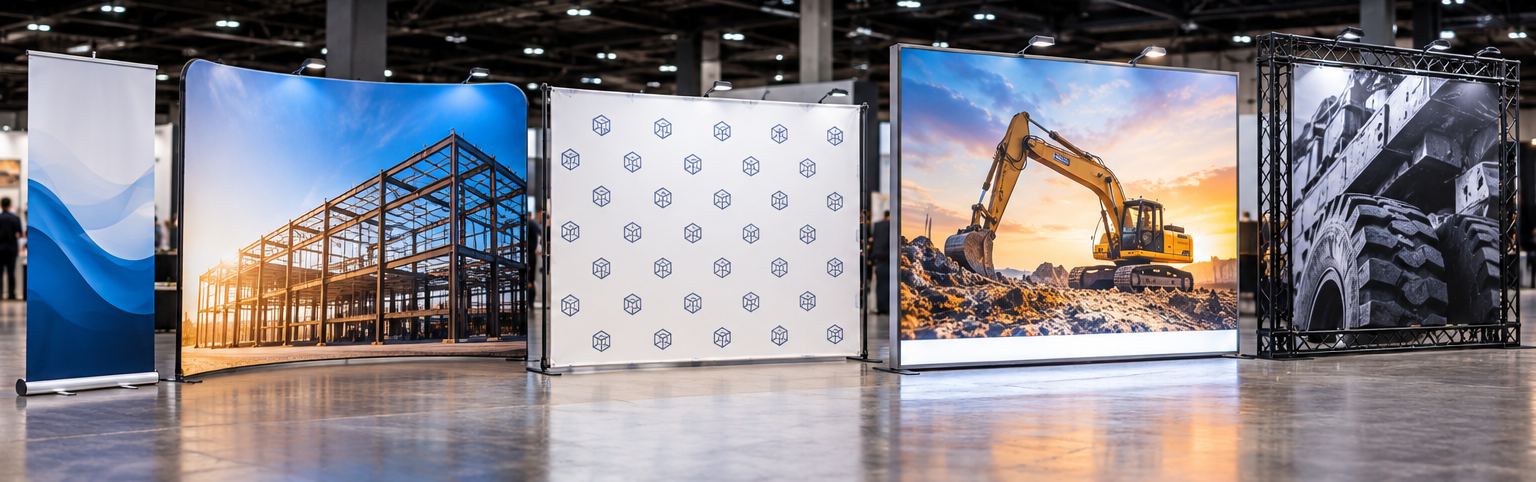
These are the main trade show booth backdrop options, from the simplest to the most complex. Price ranges include hardware and graphics and come from American Image's backdrop guide unless noted.
1. Pipe and drape banner: A printed fabric banner that clips onto the show's pipe and drape. About $150–600, with almost nothing to ship.
2. Banner stand wall: Three retractable banner stands placed side by side. About $300–900 for three. Cheap and flexible, but the gaps show.
3. Step and repeat: A logo pattern on a simple frame, built for photos. Westshade lists one at about $280, and Displays2go lists an 8x10 version at about $431.
4. Pop-up backdrop: An accordion frame that locks open without tools and takes fabric or panels. About $600–1,500 for an 8 ft pop-up, set up in 10–20 minutes.
5. Tension fabric backdrop: A printed fabric sleeve zipped over an aluminum tube frame. About $700–2,500 for a 10 ft wall, set up in 10–15 minutes.
6. SEG frame backdrop: Silicone-edge fabric pressed into an aluminum frame for an almost frameless look. About $900–4,000 for a 10 ft wall.
7. Backlit backdrop: LEDs hidden behind a translucent screen make the wall glow. Cost: around $2,500 to $8,000 for a 10 ft backlit SEG wall. Most effective in a bright hallway but requires electricity.
8. Rigid or hybrid modular wall: Aluminum extrusion that can be reconfigured between sizes. About $1,200–8,000.
9. Truss backdrop: Large truss systems for 20x20 and bigger booths. About $3,000–20,000+.
| Backdrop Type | Best For | Setup | Typical Price |
|---|---|---|---|
| Pipe and drape banner | Lowest budgets | Minutes | $150–600 |
| Banner stand wall | Flexible small booths | Minutes | $300–900 (3 stands) |
| Pop-up (8 ft) | First shows | 10–20 min | $600–1,500 |
| Tension fabric (10 ft) | Frequent travel | 10–15 min | $700–2,500 |
| SEG frame (10 ft) | A premium, clean look | 20–30 min | $900–4,000 |
| Backlit SEG (10 ft) | Bright or crowded halls | 30–45 min, needs power | $2,500–8,000 |
| Truss | 20x20 and larger | Crew required | $3,000–20,000+ |
For a full comparison of display hardware, read trade show displays: the ultimate guide, plus our guides to portable pop-up displays and SEG backlit walls.
Optimizing a 10x10 Backdrop Layout
When outfitting a standard 100-square-foot exhibit, your booth backdrop requires precise graphic positioning to maintain readability across long distances.
- Keep Primary Logos High: Position main brand logos and headlines in the top third of your 10x10 backdrop (above 5 feet) so standing crowds never block messaging.
- Limit Header Copy: Use fewer than eight words on your primary backwall to communicate your value proposition instantly to passing attendees.
- Ensure High Visual Contrast: Pair light foreground text with dark background tones to optimize legibility under varied lighting conditions.
Essential Best Practices for Exhibit Backwalls
- Use Dye-Sublimated Fabrics: Washable stretch polyester fabric prevents reflection and stays smooth across multi-day events.
- Integrate Modular Accessories: Select backdrop frames that support clip-on LED spotlights, monitor brackets, or floating product shelves.
- Verify Fire Retardant Certifications: Ensure your fabric graphics meet NFPA 701 fire safety codes required by major convention venues.
Trade Show Backdrop Sizes
Pick the width from your booth size, then check the height against the show's rules.
| Booth Size | Typical Backdrop Width | Height Note |
|---|---|---|
| Tabletop (4–6 ft table) | 3–5 ft tabletop backdrop | Sits on or behind the table |
| 10x10 inline | 8 or 10 ft | Usually 8 ft max |
| 10x20 inline | 20 ft (one unit or two 10 ft walls) | Usually 8 ft max |
| 20x20 island | 10–20 ft per open face | Often 16–20 ft, with approval |
Widths follow American Image's sizing guide. Under the IAEE display guidelines, inline booths generally have an 8-foot back wall limit, and anything in the front half of the booth is limited to 4 feet. Perimeter booths can usually go to 12 feet, and islands to 16–20 feet (IAEE). Some 10-foot backdrops sold online are also 10 feet tall, so confirm the height before you buy.
For size-by-size planning, see the 10x10 trade show booth guide and our trade show booth sizes comparison.
Trade Show Backdrop Design Tips
- One strong message that can be read at 20 feet away – no paragraphs
- Logo located in the top third to remain visible above crowds and counters
- Leave the bottom 18-24 inches open as tables and counters obscure the sign
- Strong contrast between text and background color – hall lights are even
- One strong graphic as opposed to a collage of graphics
- One strong benefit message as opposed to only a company name
These rules follow American Image's design advice. For more ideas, see 50 creative exhibit booth design ideas and our trade show booth design guide.
File and Print Specs for Backdrop Graphics
- Resolution – At least 100dpi at actual size for walls viewed from 5 feet away or further; 150 dpi is better
- Scaled artwork – If your work is done at quarter-scale, the images should have that resolution at actual size
- Color – Use RGB for backlit fabric and provide an embedded color profile
- Bleed – Use bleed according to the printer’s templates
- File formats – PDF, TIF, PSD, EPS, and AI in good quality; avoid Word or PowerPoint files
- Templates – Always design using the manufacturer's template for your particular frame
Specs come from TradeShowDisplayPros' file specifications. Ask for a printed proof before the final run.
Fabric vs Vinyl Backdrops
The dye-sublimated fabric material is the one being used as the trade show backdrop today. It is wrinkle-free, crack-proof, non-reflective, can be machine-washed, and the 10-foot-wide fabric surface will only weigh a few pounds. The vinyl is much heavier and easily creases, which makes it more suitable for installations rather than portable graphics. Replacement fabric graphics cost about 20-40% of the original package price, says American Image.
Lighting Your Backdrop
- Back-lit walls – Best choice in brightly lit or busy halls
- Arm lights or spotlights – More affordable method of lifting a front-lit image
- LED edge lighting – Defines the outline of the backdrop and the frame
- Electrical power – Order electrical power for the show for a lit backdrop
See our trade show lighting setups guide for options by booth size.
Fire Safety Rules for Backdrops
Most venues require booth fabric to be flame retardant, but the paperwork differs by city. McCormick Place in Chicago says fabrics must pass NFPA 701, lists backdrops among them, and suggests keeping a certificate on hand to avoid on-site testing. At the Anaheim Convention Center, NAMM's rules ask for a California State Fire Marshal certificate or equivalent for drapes and decorative fabric at least 14 days before the show. Ask your supplier for the certificate and check your exhibitor manual.
Shipping, Setup, and Storage
- Portable backdrops ship in one or two cases and set up in under 30 minutes
- Lighter backdrops cut freight and drayage costs, which are billed by weight
- Roll or fold fabric graphics as the maker recommends to avoid creases
- Store frames dry, and wash fabric graphics before storing if they are marked
Buy or Rent a Trade Show Backdrop?
Buy a portable backdrop if you exhibit two or more times a year in the same booth size; it pays for itself quickly. Rent if you exhibit rarely, need a large or custom wall, or fly to distant shows. A trade show booth rental or modular booth can include the backdrop, graphics, and setup. For low-budget options, see trade show booth on a budget.
Common Trade Show Backdrop Mistakes
- Too much text on the wall
- Logo placed low, hidden behind the table
- Buying a 10-foot-tall backdrop for an 8-foot limit
- Low-resolution images that look blurry at full size
- No flame certificate on hand
- No lighting in a dim corner of the hall
Final Thoughts on Trade Show Backdrops
Your trade show backdrop does the work before anyone on your team says a word. Choose the type that fits how often you exhibit, size it to your booth and the show's height rules, and spend the design effort on one clear message that reads from across the aisle.
What matters are the things that will move the needle – the headline, the positioning of the logo, the lighting, and the frame that you can erect easily. These four elements determine whether the wall works.
Do not forget the compounding nature of all of this. The frame will last you a long time, while reprinting just the graphic makes your booth relevant at a fraction of the initial price.
Lastly, keep in mind the reason why you’re doing this. The backdrop is simply a tool – a way of generating more conversation and contact with actual buyers. Use that as the criterion of success.
What to Look for in a Trade Show Booth Backdrop Partner
The solution depends greatly upon who designs and implements your exhibit booth. An experienced partner is not just one who designs a booth but is proactive in problem-solving, keeps your project on track, and accepts responsibility from the drawing board to dismantling it. When choosing a partner, go beyond the cheapest bid and consider their capabilities, transparency, and expertise in events and spaces such as yours.
- Graphics produced in-house with printed proofs
- Templates specific to your unique frame
- Fire certificates provided with all fabric graphics
- Tips regarding proper height restrictions for your booth type
- Detailed price quote on frame, graphic, lighting, and cases
- Accountable single contact from beginning to end
How Exhibitorly Can Help
Exhibitorly is a free marketplace that will pair you with qualified trade show booth builders around the US. Rather than having to reach out to builders individually, you fill out a single quick form including details on your show, booth size, schedule, and budget. In just 24 hours, we’ll match you with up to three builders familiar with your show and venue, and you’ll get 3D booth concepts, project scope, and clear pricing for comparison all at once. You will also be able to see how each builder plans your backdrop if it is part of an overall booth package.
- One brief, up to three proposals from screened builders
- Matching by show, venue, industry, booth size, and budget
- 3D booth concepts and detailed pricing in a consistent format
- Custom, modular, rental, and turnkey packages for any budget
- Builders in Las Vegas, Chicago, Orlando, Anaheim, and 50+ US cities
- Absolutely free for exhibitors, no commitment required
For related reading, explore what a trade show booth is, our trade show checklist for exhibitors, and turnkey trade show services.