

What Is Drayage at Trade Shows? Costs and How to Reduce Them
Drayage is the charge for moving your freight from the loading dock or advance warehouse to your booth and back again, and it is rarely included in the booth price. This guide explains what drayage covers, how general service contractors bill it per hundredweight (CWT), and what exhibitors typically pay in 2026. It compares shipping to the advance warehouse with shipping direct to the show site, flags the extra charges that catch exhibitors out, and lists practical ways to cut your drayage bill, with notes on major exhibiting cities.
Trade show drayage is one of the least understood line items on your trade show invoice, and one of the most costly. Trade show drayage charges you for the cost of transporting your freight to your booth and back, separate from your booth itself. This resource outlines everything that drayage includes, how drayage costs are determined, the cost of drayage in 2026, and how to cut down on it.
Drayage surprises first-time exhibitors because it is rarely included in the booth price, and a builder who quotes logistics up front, such as a turnkey trade show services partner, makes that cost visible from day one. For the bigger picture of freight, warehousing, and move-in, see trade show logistics 101.
What Does Drayage Mean?
In freight, drayage is the short-distance move of goods by truck between transport modes; for example, from a port to a nearby warehouse or rail ramp. At a trade show, the drayage definition narrows to material handling inside the venue. The show's general service contractor, such as Freeman or GES, usually holds exclusive rights to move freight on the floor.
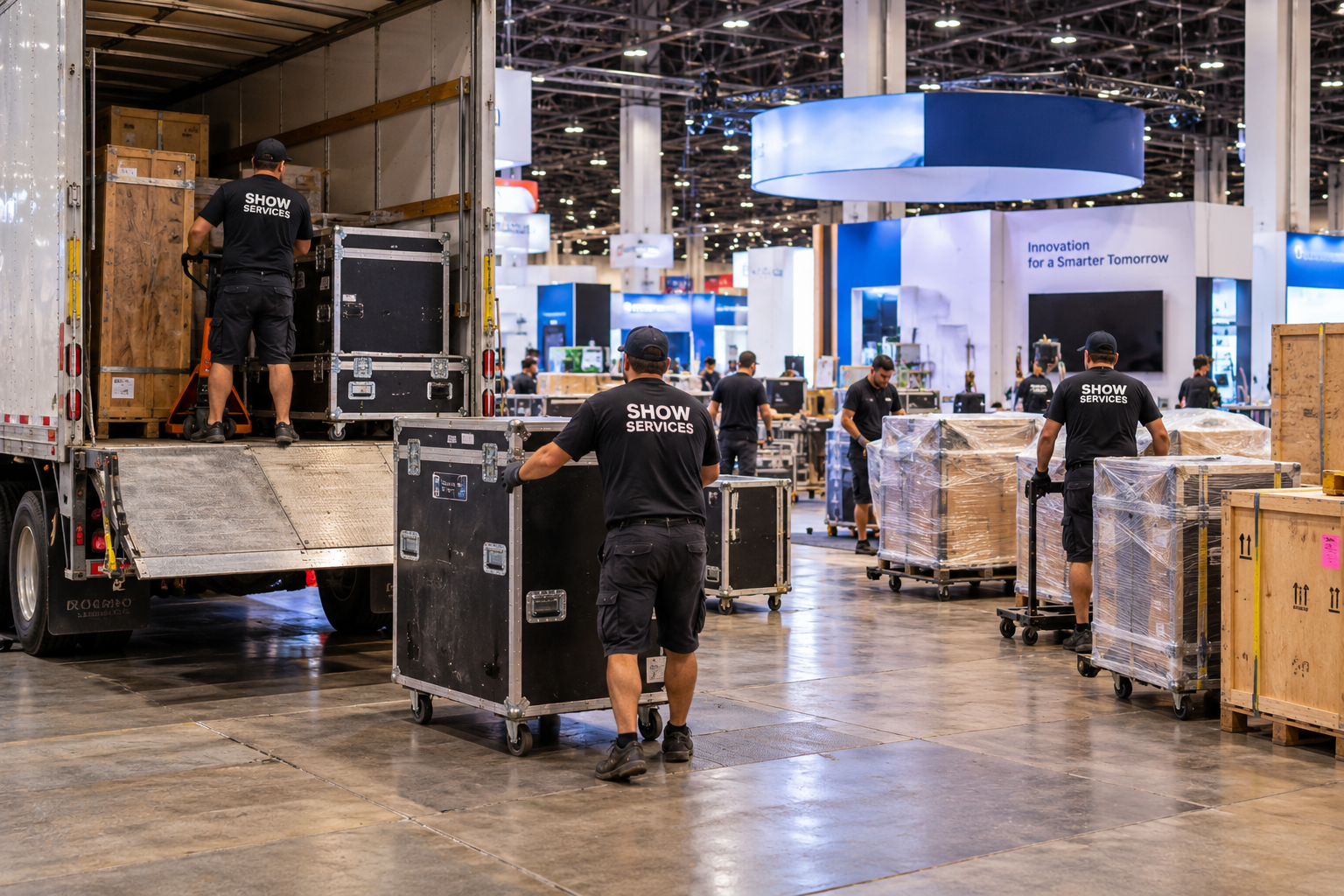
What Trade Show Drayage Covers
A standard drayage charge covers the full round trip, according to GES:
- Unloading your freight at the dock or the advance warehouse
- Delivering it to your booth before move-in
- Storing your empty crates during the show
- Returning the empties to your booth at close
- Moving packed freight back to the dock for your outbound carrier
The Core Drayage Definition and Scope
A precise drayage definition encompasses every movement of your exhibit assets within the exhibition hall boundaries.
Drayage does not include trade show shipping to and from the venue; that is a separate bill from your carrier. Union rules at many venues also limit what you can hand carry, so check the exhibitor manual first and keep our trade show checklist for exhibitors handy.
Decoding Drayage Cost and Pricing Factors
Managing your event budget effectively requires knowing how drayage cost is calculated. General service contractors charge for trade show drayage per CWT, which stands for hundredweight (per 100 pounds). Shipments are almost always rounded up to the nearest hundredweight, and most venues enforce a strict minimum weight threshold (such as 200 pounds).
Several variables influence your final drayage fees:
- Weight: Every pound adds to your total CWT calculation.
- Delivery Location: Shipping to an advance warehouse versus shipping direct to the show site alters your rate structure.
- Timing: Deliveries arriving outside the published window or during overtime hours trigger steep surcharges.
How to Optimize Your Logistics Strategy
Controlling your material handling expenses requires proactive planning. Consolidate separate shipments into unified crates to avoid paying multiple minimum weight charges. Furthermore, utilize lightweight modular booth structures and digital collateral instead of heavy printed manuals to slash total shipment weight.
You can browse vetted trade show booth builders by city and show, or read how Exhibitorly works before you submit a brief.
How Drayage is Calculated
Most contractors bill per CWT, meaning per hundredweight, or 100 pounds. Three rules decide the number:
- Weight: each shipment is billed by the hundred pounds
- Rounding: weight usually rounds up, so a 212 lb crate bills as 3 CWT
- Minimums: a 200 lb minimum per shipment is common, even for one small box
Here is how those rules play out at an illustrative rate of $140 per CWT:
| Shipment | Actual Weight | Billed As | Drayage at $140/CWT |
|---|---|---|---|
| One crate | 212 lb | 3 CWT | $420 |
| Five 40 lb boxes, shipped separately | 200 lb | 10 CWT (five minimums) | $1,400 |
| The same five boxes, shipped together | 200 lb | 2 CWT | $280 |
| 10x20 booth | 2,400 lb | 24 CWT | $3,360 |
Same boxes, same weight, five times the bill. Consolidating freight is the single easiest way to cut drayage. To see what a typical footprint weighs and holds, compare our 10x10 booth guide and 10x20 booth guide.
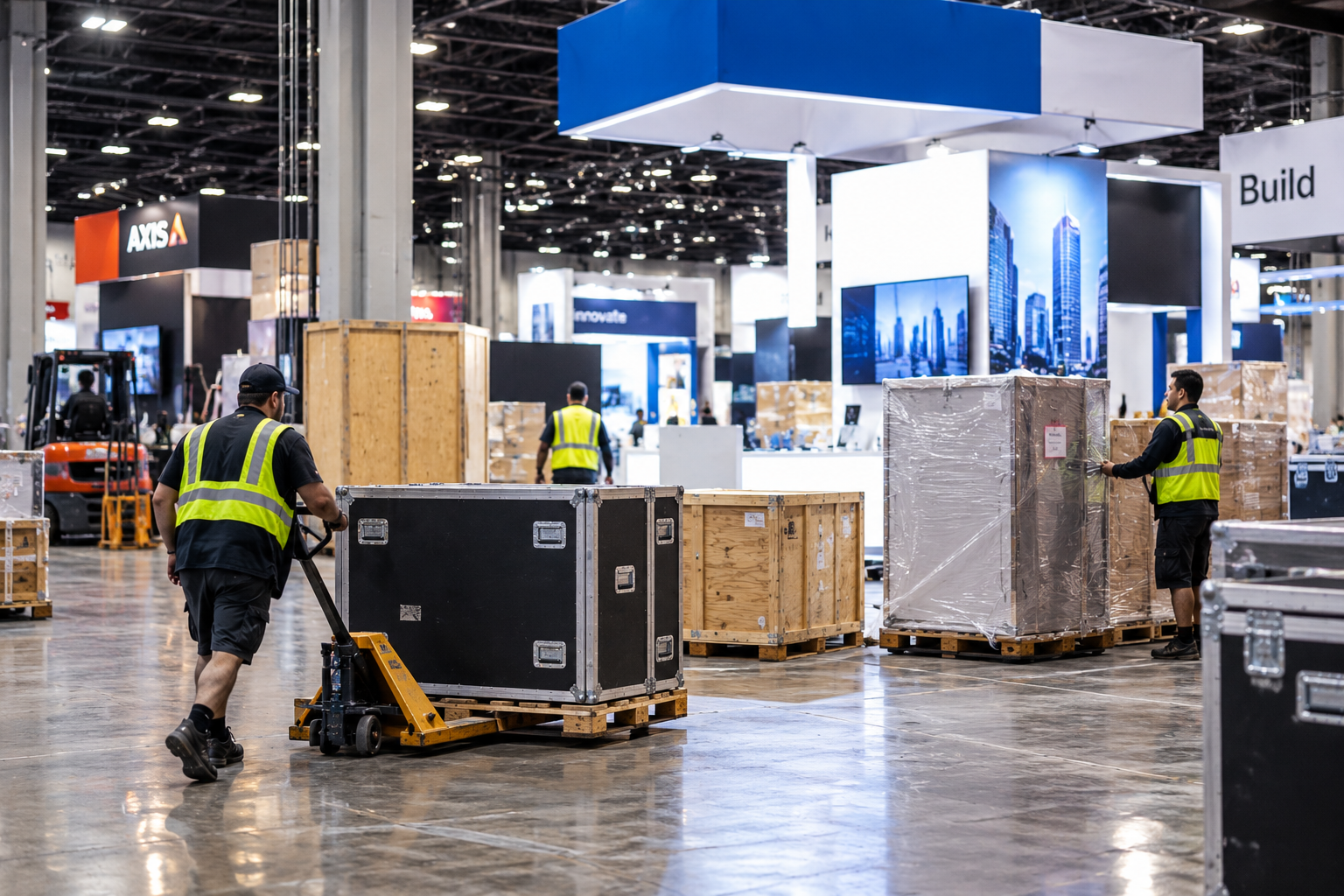
How Much Does Trade Show Drayage Cost?
Rates are set per show and per city, based on local union labor and show production costs. As a 2026 benchmark, Steadfast Displays puts crated freight at about $110–185 per CWT through the advance warehouse and $95–165 per CWT direct to the show site. The type of freight matters as much as the weight:
| Freight Category | What It Means | How It Is Billed |
|---|---|---|
| Crated or skidded | Crates, cases, and pallets unloaded by forklift | Lowest per-CWT rate |
| Special handling | Loads packed by cubic space, side-door or stacked loads, mixed shipments | About 25–45% above crated |
| Uncrated | Loose or pad-wrapped freight, machinery without skids | Highest rate, often 50%+ above crated |
| Small package | Small cartons from parcel carriers under a weight cap | Flat fee, about $45–75 per shipment |
Real show kits confirm the gap. At a Freeman-serviced meeting in Boston, crated freight sent direct cost $128.70 per CWT, while uncrated freight cost $193.05, and the warehouse would not accept uncrated freight at all. Build these numbers into your plan with our trade show budget planning guide.
Advance Warehouse vs. Direct to Show Site
You can ship to the contractor’s advance warehouse prior to the show or directly to the venue on the day of your move-in. Each has pros and cons.
- Advance warehouse – accepts freight up to 30 days before move-in
- Advance warehouse – freight is at your booth when you arrive; receipt is confirmed
- Direct to show – usually cheaper; however, it depends on your carrier’s unloading window
- Both – surcharges for freight that does not fall within the published window
Warehouse rates are often higher, but not always. At the 2022 NACS Show in Las Vegas, crated freight cost $109.25 per CWT at the warehouse versus $92.50 at the show site, while the Boston kit above ran the other way. Always compare both rates in your own show's manual. Exhibiting in Las Vegas? Our guide to Las Vegas trade show services explains how the main contractors there handle freight.
Drayage Charges That Catch Exhibitors Out
- Overtime – anything beyond normal time (typically 8 a.m. to 5 p.m.) on weekdays is 25-50% more expensive
- Late or early arrivals – GES imposes a 25% extra charge for anything that does not fit within the warehouse hours
- Special handling and uncrated freight – awkward cargoes are charged higher rate classifications
- Split shipments – each shipment can result in a new minimum being imposed
- Outbound paperwork shortage – the cargo may be returned by the house carrier at your expense
Some shows have simplified pricing. At the 2022 SEMA Show, Freeman charged a flat per-pound rate with no minimums, no overtime, and no special handling fees. Read your kit before you assume the old rules apply, and plan your move-in slot with our install day guide.
How to Reduce Drayage Costs
- Read the exhibitor’s manual well in advance and mark all deadlines
- Combine everything in one shipment
- Properly crate the shipment to get the best rate
- Take advantage of the advance warehouse window period – not early, not late.
- Schedule straight-time move in and out
- Select a lightweight booth using an aluminum frame and graphic walls
- Rent locally at the show city to avoid long-distance shipping
- Save certified weight ticket to dispute billing mistakes
- Complete the outbound paperwork on time
- Get an itemized quote from your booth builder separating freight, drayage, and labor charges.
Booth choice has the biggest long-term effect. Modular booths pack into fewer, lighter cases; see our modular trade show booths guide, and portable pop-up displays can often ship as a single case. A trade show booth rental from a builder near the venue can remove long-haul freight altogether. More savings ideas are in our guide to a trade show booth on a budget.
Drayage in Major Exhibiting Cities
This is because drayage rates depend on the local cost of labor. The same booth might be expensive to manage in one city compared to the other. The construction workers who work every month in the city know the contractors and the dock schedules. Compare local partners in the busiest markets:
- Las Vegas: see our Las Vegas Convention Center guide
- Chicago: see McCormick Place events
- Orlando: see Orange County Convention Center events
- Anaheim, Atlanta, and New York: local builders who know each venue's dock rules
Final Thoughts on Trade Show Drayage
Drayage is not a hidden fee so much as an overlooked one. Every show publishes its material handling rates, deadlines, and rules in the exhibitor kit, and exhibitors who read it early rarely get surprised.
It helps to focus on the levers that actually move the number: weight, freight category, number of shipments, and timing. Those four factors explain most of the gap between a reasonable drayage bill and one that rivals the booth itself.
Do not forget about the compounding effect. The lighter booth, a standard crating system, and a manufacturer who quotes shipping fees from the start will reduce the cost of transporting your trade show material at each event you attend.
And, lastly, do not forget what you came for. Each dollar you save through drayage is the money you can spend at the booth, in the booth, and on the follow-ups to make the sale.
How Exhibitorly Can Help
Much of the results will depend upon the people who construct and run your booth. The correct exhibit partner does not just construct a booth but foresees problems, keeps your project on track, and is responsible for what happens from initial sketches until final dismantling. Here are some things that you should consider while selecting partners beyond the cheapest quotation.
- Lightweight and compact crating booth designs
- Logistics and drayage services included in the scope of work
- Experience with your venue's contractors, deadlines, and union regulations
- Detailed pricing structure dividing booth, freight, drayage, and labor
- Rental/local options if appropriate in the show city
- One person who is accountable throughout the whole process
For related reading, explore the ultimate guide to hiring a trade show booth builder, our trade show ROI guide, and the upcoming trade shows calendar.