

Trade Show Booth Design: The Complete Guide for Exhibitors
A strong trade show booth design stops people in the aisle, holds them long enough to talk, and turns the visit into a lead. This guide walks through designing a booth in nine steps, from setting one goal and reading your show's rules to zoning the floor, writing the message, and planning graphics, lighting and technology. It covers layouts for 10x10, 10x20, peninsula and island booths, typical height rules by booth type, where to spend the design budget, 2026 trends, and the mistakes that cost exhibitors leads.
Planning a successful commercial exhibit requires a sharp approach to trade show booth design, as your visual display determines how effectively your brand captures attendee attention on a busy floor. Whether you are building an inline footprint or a large island exhibit, executing strategic trade show booth designs ensures your team converts casual foot traffic into qualified sales leads.
This guide provides proven concepts, graphic rules, and layout strategies to help you master trade show booth design and maximize your event return on investment.
Every design still has to be built, and you can compare 3D concepts from vetted trade show booth builders before you commit. Looking for inspiration first? Browse our 50 creative exhibit booth design ideas.
What is Trade Show Booth Design?
A trade show booth design is the strategic arrangement of physical exhibit hardware, visual graphics, lighting, and interactive elements within a designated exhibition floor space. The primary goal of a trade show exhibit design is to communicate a brand's value proposition quickly, guide foot traffic naturally, and provide comfortable zones for staff to qualify leads and conduct business meetings.
Key Principles of Effective Booth Design
Before picking colors or ordering graphics, successful exhibitors build their layout around three core spatial principles:
- The 30-Foot Rule: Your primary brand name and main value statement must be easy to read from 30 feet away. Keep messaging concise and place your logo high on the back wall.
- Clear Footprint Flow: Leave at least 40 percent of your floor space open. Overcrowding your area with heavy furniture signals to attendees that your space is hard to enter.
- Dedicated Space Zoning: Divide your floor plan into distinct functional areas. Use the aisle front to attract visitors, the center to demonstrate products, and the back section for private meetings.
What Good Trade Show Booth Design Does
Every effective booth does three jobs, in order.
- Stop: one message or visual that reads from the aisle in a few seconds
- Engage: a demo, conversation, or experience that holds people for a few minutes
- Capture: a badge scan, booked meeting, or next step that turns attention into a lead
Our guide on what the three-second rule means at NRF shows how to test whether a booth communicates fast enough.
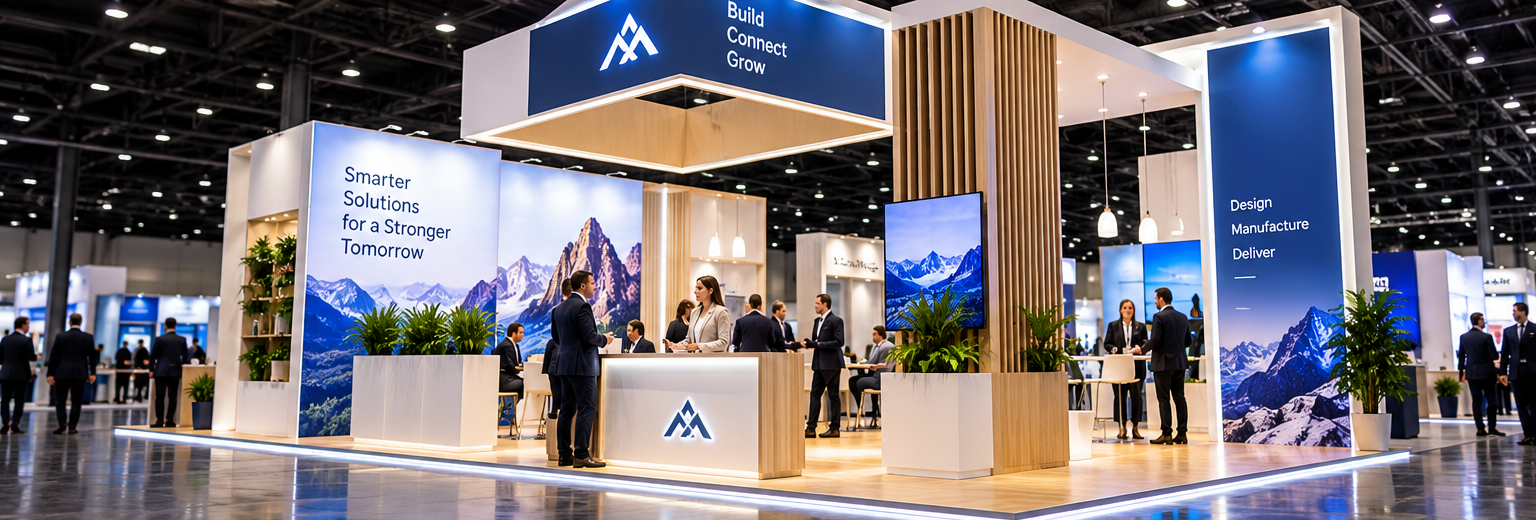
How to Design a Trade Show Booth in 9 Steps
1. Set one goal and one metric: Leads, meetings, product launch, or awareness. Pick the main one and decide how you will measure it, because the goal shapes every other decision.
2. Know your booth type and the rules: Inline, corner, peninsula, and island booths all have different height and line-of-sight limits. Read the exhibitor manual before anyone draws a sketch.
3. Zone the floor: Divide the space into an attract zone at the aisle, an engage zone for demos, and a quieter zone for meetings. Protect open walking space.
4. Write the message hierarchy: Logo, one headline, and one supporting line. Everything else belongs on a screen or in a conversation.
5. Design the graphics: Place the logo and headline high, use large type and strong contrast, and use photos at a resolution that holds up when printed large.
6. Plan lighting: Hall lighting is flat. Backlit walls, LED accents, and spotlights make the booth readable: see our trade show lighting setups guide.
7. Add technology with a purpose: Screens, touch demos, and AR should prove a point about the product. Plan power, internet, and a fallback if the network fails.
8. Design around your staff: Mark where each person stands, where bags and samples go, and where meetings happen.
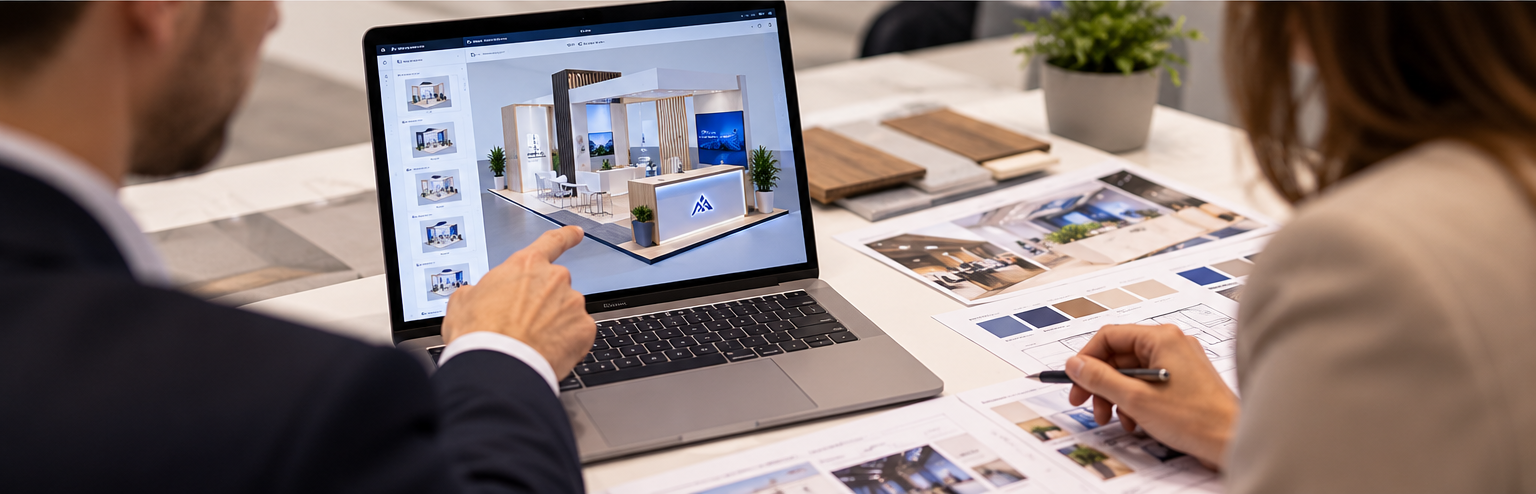
9. Choose the build type and review in 3D: Decide between rental, modular, and custom trade show exhibits, then review a 3D rendering before anything is built.
How to Design a Trade Show Booth by Footprint Size
Knowing how to design a trade show booth depends directly on your assigned square footage and floor position.
10x10 Inline Displays
Standard 10x10 spaces face one main aisle. Focus on a single central message with a high-contrast backlit backdrop. Use a slim counter at the front edge to manage lead check-ins without blocking entry paths.
10x20 Expanded Layouts
Double inline footprints give you extra width to establish two distinct zones. Position an interactive product demonstration on one side and a comfortable seating area on the other to hold extended conversations.
Peninsula and Island Exhibits
Peninsula spaces face three aisles, while island booths stand free on all four sides. These large layouts require 360-degree visual planning. Incorporate overhead hanging signs to stay visible across the entire hall, and position central towers to store extra supplies securely out of sight.
Underrated Trade Show Booth Design Tips
Applying targeted trade show booth design tips keeps your presentation polished and professional:
- Position Branding High: Place logos and core headlines above 5 feet so standing crowd traffic never blocks your messaging.
- Use Backlit Tension Fabric: Illuminated LED backwalls eliminate shadows and pull attendees' eyes straight to your graphics under harsh hall lights.
- Maintain High Graphic Contrast: Combine dark background colors with vibrant foreground text to maintain readability across long distances.
- Limit Wall Text: Keep your backdrop header under 8 words. Use physical handouts or digital QR codes to share detailed product specs.
Booth Types and the Design Rules That Shape Them
Display rules vary by show, but most follow IAEE guidelines. For inline booths, the 2023 IAEE update sets a typical 8-foot back wall limit, with anything in the front half limited to 4 feet. The IAEE guidelines for other booth types give the typical limits below.
| Booth Type | Open Sides | Typical Max Height | Hanging Signs |
|---|---|---|---|
| Inline (linear) | 1 | 8 ft back wall; 4 ft in front half | No |
| Corner | 2 | Same as inline | No |
| Perimeter | 1 (backs onto hall wall) | 12 ft back wall | Usually no |
| End-cap | 3 | 8 ft in rear half; 4 ft elsewhere | Not permitted |
| Peninsula | 3 | 16–20 ft at center of back wall | Usually yes |
| Island | 4 | 16–20 ft, including signage | Usually yes |
Always confirm the numbers in your own show's exhibitor manual, because organizers can set different limits. Compare footprints in our trade show booth sizes guide.
Trade Show Booth Layout: Designing for Flow
- Leave the aisle edge open – counters and tables at the front are like a wall.
- Put the best visual where there is most traffic.
- Put demos where a small crowd won’t obstruct the aisle.
- Put meetings and storage at the back or middle.
- Islands – all four sides should be fronts.
For size-specific plans, see our 10x10 booth guide, 12 floor plans for a 10x10, the 10x20 booth guide, and the 20x20 island booth guide.
Graphics and Messaging
- Headline describing one benefit instead of a slogan
- Logo and headline placed above 7 feet, out of the way of crowds
- High-contrast large lettering visible from the other side of the aisle
- Photographs of real products rather than stock photographs
- Screens or personal conversation to deliver details, not the back wall
For hardware and printing options, read our trade show displays guide, including SEG backlit walls and portable pop-up displays.
Technology, Demos, and Experiences
Attendees increasingly want to do something, not just read something. The author of CEIR's report on booth engagement says people "crave experiences" more than information. The best experiences prove a point about the product in a few minutes.
- Hands-on demos at the aisle edge
- Touchscreen configurators or calculators
- Short, scheduled presentations
- AR to show products too large for the booth
- Badge scanning tied to every experience: see trade show lead retrieval
For real examples, see what worked at NAMM 2026 and CES booth design lessons from 2026.
Safety, Accessibility, and Sound
The IAEE guidelines also cover rules that designers often forget.
- Accessibility – exhibitors have to follow the Americans with Disabilities Act
- Fire safety – all display material must be fire-retardant and certified
- Sound – the speakers must be oriented inward, and the rule of thumb is 85 dB from the aisle
- Demo – keep the people in your space; dangerous demo requires a setback or a barrier
- Structures – elevated exhibits and towers may require a permit and approved drawings
Furniture, Flooring, and Storage
The floor defines the edge of the booth, the furniture indicates whether people are invited to remain, and storage hides any bags and boxes. All these should be considered during the planning phase, not at move-in time. See our trade show furniture and flooring guide.
Where to Spend the Design Budget
| Spend More On | Why | Spend Less On |
|---|---|---|
| Headline and graphics | Seen by everyone who passes | Wall-to-wall text |
| Lighting | Makes everything else readable | Decorative props |
| The demo or experience | Holds people and creates leads | Bulk giveaways |
| Staff training | Turns visits into conversations | Extra floor space you cannot staff |
Our trade show budget planning guide and trade show booth on a budget guide show how to stretch every dollar. Remember that heavy materials raise freight and drayage costs at every show.
Trade Show Booth Design Trends for 2026
- Quieter, more open floors with fewer, larger visuals
- Storytelling and live demos over spec sheets
- Hospitality as strategy: coffee bars, lounges, meeting pods
- Natural materials and reusable fabric graphics
- Technology that visitors use, not just watch
Read more in modern booth design trends for 2026.
Common Trade Show Booth Design Mistakes
- Designing before setting a goal
- Too much text on the back wall
- A counter blocking the front of the booth
- Logo placed low, where people hide it
- No storage, so clutter ends up in view
- Ignoring the show's height and line-of-sight rules
- No plan for capturing leads
Comparing Design Styles and Hardware Systems
| Design Style | Primary Advantage | Best Footprint | Setup Complexity |
|---|---|---|---|
| Pop-Up & Portable | Tool-free assembly, lightweight travel | 10x10 Inline | Low (15 Minutes) |
| Tension Fabric Lightbox | Backlit graphics, smooth glare-free finish | 10x10 to 10x20 | Moderate (30 Minutes) |
| Modular Aluminum Frame | Flexible layouts, supports TV mounts | 10x20 to 20x20 | Moderate (1 Hour) |
| Custom Architectural Build | Bespoke structural shapes and multi-deck levels | Island (20x20+) | High (Multi-Day) |
Optimizing Your Trade Show Booth Layout for Engagement
A well-planned trade show booth layout guides visitors seamlessly from initial curiosity to active conversation. Start by creating an open entry pathway at the aisle margin. Position interactive touchscreens or product samples near the center line to give visitors something to explore hands-on.
Keep your staff positioned near the sides or rear of the space rather than standing in a rigid line across the front. This open arrangement makes your exhibit feel welcoming and encourages passersby to step inside.
Final Thoughts on Trade Show Booth Design
The best trade show booth designs share one trait: every element serves a single, clear goal. A strong headline, an open layout, good lighting, and a demo that proves the point will outperform a bigger budget spent without direction.
It’s important to think about the components that will make it happen – what people see when they’re walking down the aisle, what they do when they enter, and how you secure your position once you have captured their attention. These are the three factors that determine whether or not the booth will pay for itself.
And remember, this builds up – every trade show will teach you something about your booth design, and exhibitors who evaluate and improve upon their booth designs following each one will continually get better.
Lastly, don’t forget why you’re even there in the first place – booth design is just a tool for making it happen.
What to Look for in an Exhibit Partner
The success is greatly influenced by your choice of a booth builder and partner. The right partner doesn't only build you the booth but anticipates possible difficulties, keeps your project on time, and is truly responsible from the very first sketch until the very last dismantling. When evaluating your partner, don't get carried away by the price that seems the lowest, but check their qualifications, transparency, and experience in working on similar events and venues.
- In-house designers working from your brief rather than using templates
- 3D renders and at least one revision
- Experience working with shows similar in size and safety regulations
- Truthful recommendations on renting, modularity, or custom-building for your schedule
- Detailed pricing of all the stages of design, build, graphics, and logistics
- Single responsible contact from briefing to dismantling
How Exhibitorly Can Help
Exhibitorly is a free platform where exhibitors find top-notch trade show booth constructors anywhere in the United States. You do not have to contact every builder individually; instead, you send us your one brief describing the show, the size of the booth, the timeline, and budget. In less than 24 hours, you will be matched with up to three builders familiar with the venue and your show and will get 3D concepts, scope of work, and transparent pricing for comparison.
- One brief, three proposals from builders
- Matching based on show, venue, industry, booth size, and budget
- 3D booth concepts and pricing details in one format
- Modular, custom, rental, and turnkey booths for any budget
- Builders in Las Vegas, Chicago, Orlando, Anaheim, and over 50 US cities
- Free for exhibitors without any obligations
For related reading, explore our trade show booth design guide for first-time exhibitors, custom trade show booths, and the ultimate guide to hiring a trade show booth builder.